

 Nyah Eliud
Key takeaways
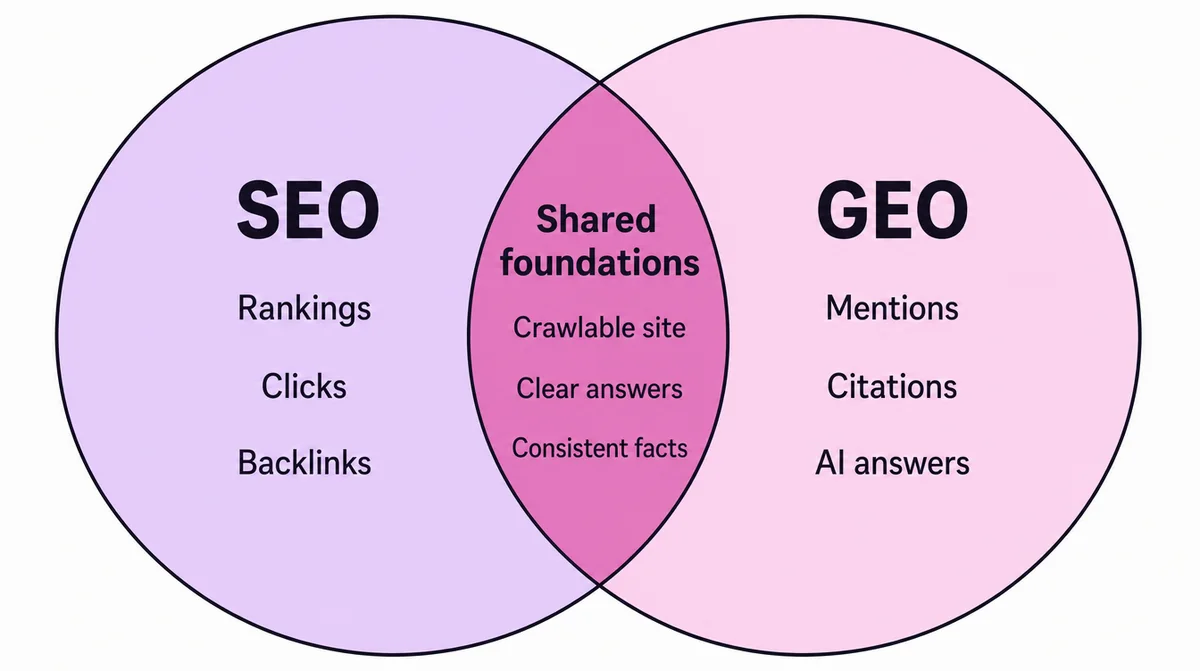
- SEO gets your pages ranked in a list. GEO gets your business named inside the answer an AI assistant gives. Most of the work is shared.
- For Google’s AI Overviews, Google says no special optimisation is needed: good SEO is the requirement.
- Other assistants reward consistent, factual information about you across the web, and pages that answer questions plainly.
- Research on generative engines found that adding statistics, quotations and cited sources raised visibility, while keyword stuffing made it worse.
- Do not block OAI-SearchBot if you want to appear in ChatGPT search answers, and measure progress by asking the same questions every month.
The short answer
Search engine optimisation, SEO, is the work of getting your pages to rank in a list of results. Generative engine optimisation, GEO, is the work of getting your business named inside the answer an AI assistant writes. When somebody asks ChatGPT, Gemini, Perplexity or Google’s AI Overviews for the best tiler in Douala, there is no page two. The assistant names two or three businesses, and the rest do not exist for that customer.
The good news for a small business in Cameroon is that the two overlap heavily. Most of what makes an assistant name you is what makes Google rank you, plus one extra discipline: making sure the facts about your business are clear and consistent everywhere they appear. Almost nobody in this market is doing that deliberately yet.
How AI assistants decide what to say
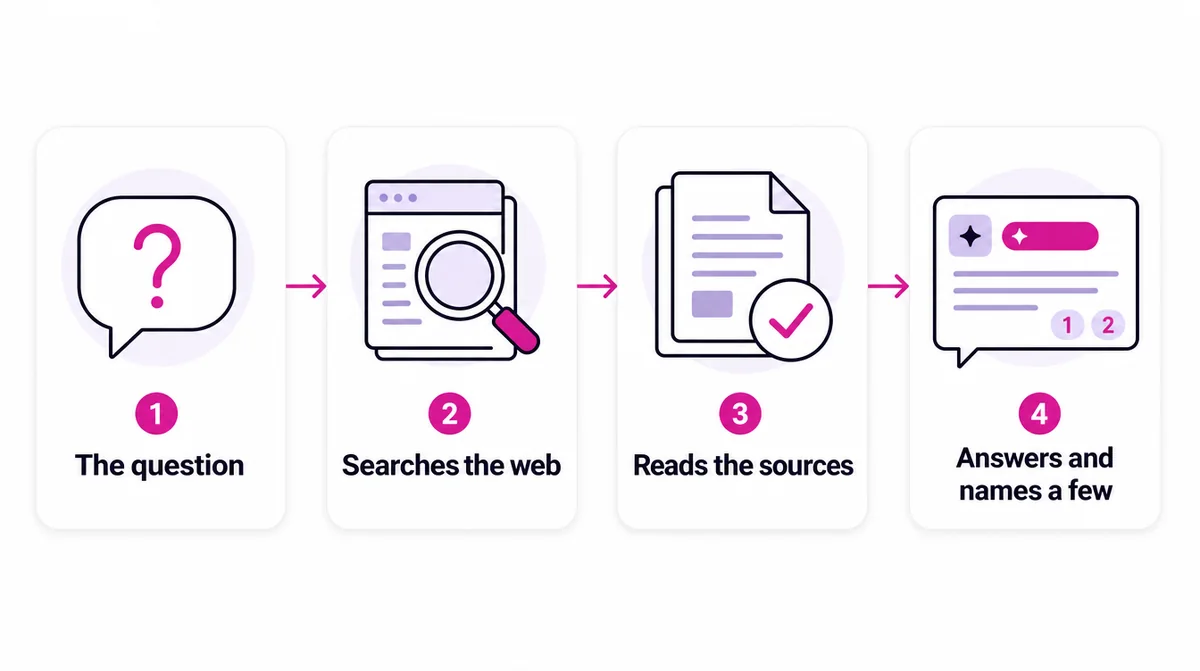
Each assistant works a little differently, but the pattern is similar. For a question about a local service, most of them search the web, read a handful of sources, and write an answer that names a few businesses, often with links to where the information came from.
| Assistant | Where its answers come from | What you can control |
|---|---|---|
| Google AI Overviews and AI Mode | Google’s own search index | Being indexed and eligible for a normal search snippet |
| Gemini app | Google’s systems and its own knowledge | Your Google Business Profile, your site, and the Google-Extended setting |
| ChatGPT | Its training data, plus web search for current questions | Not blocking OAI-SearchBot; clear, consistent information |
| Perplexity | Live web search, with numbered sources | Pages that are easy to quote and well corroborated |
| Claude | Its training data, plus web search where enabled | Accurate pages and consistent details elsewhere |
Two consequences follow. First, an assistant can only name you if the sources it reads mention you. Second, it tends to trust what several sources agree on. A business described the same way on its website, its Google profile and three directories is far easier to name confidently than one described three different ways.
SEO and GEO compared
| SEO | GEO | |
|---|---|---|
| Goal | Rank a page in the results | Be named in the answer |
| Unit of success | A position and a click | A mention, ideally with a link |
| What it reads | Your pages and the links to them | Your pages, profiles, directories, reviews and mentions |
| Rewards | Relevance, quality, authority | Clarity, factual detail, corroboration across sources |
| Measured with | Search Console, analytics, enquiries | A fixed set of questions asked every month |
| Timescale | Weeks for technical fixes, months for rankings | Months, and it varies by assistant |
Our SEO guide for Cameroon covers the foundations in full. This post is about the extra layer.
What the research says actually works
The term GEO comes from a 2023 research paper by a team from Princeton University and partners, later presented at the KDD 2024 conference. The researchers tested ways of rewriting web content to see which ones made generative engines quote it more. Their headline finding was that the best methods improved visibility in AI answers by up to about 40 percent.
| Method tested | Effect on visibility in the study |
|---|---|
| Adding relevant quotations | Roughly 41% higher on the paper’s main measure |
| Adding statistics | Roughly 31% higher |
| Improving fluency and readability | Roughly 28% higher |
| Citing sources | Roughly 27% higher |
| Keyword stuffing | Slightly worse than doing nothing, about 8% lower |
Two cautions. This was a controlled experiment, not a guarantee of how any particular assistant behaves today, and the authors found the effect varied by subject. But the direction is consistent with everything else we see: assistants favour content that is specific, factual and verifiable, and they ignore the tricks that once worked on search engines.
What this means in practicePut real numbers on your pages: prices, timescales, quantities. Quote people who know the subject. Link to your sources. And stop repeating keywords, which the study found made things worse.
Step 1: get the SEO foundations right
Google is explicit that there are no extra requirements and no special optimisations needed to appear in AI Overviews or AI Mode. A page has to be indexed and eligible to show a normal snippet. Google also says you do not need new AI text files or special markup for this. So the first GEO task is simply good SEO:
- Every important page indexed, with nothing blocked by mistake
- Fast and usable on a phone
- One page per service, each answering its search plainly
- A complete Google Business Profile with steady reviews
- Structured data that matches what the page visibly says
If those are not in place, fix them before anything else. Our ranking checklist is the order we work in.
Step 2: let the right crawlers in
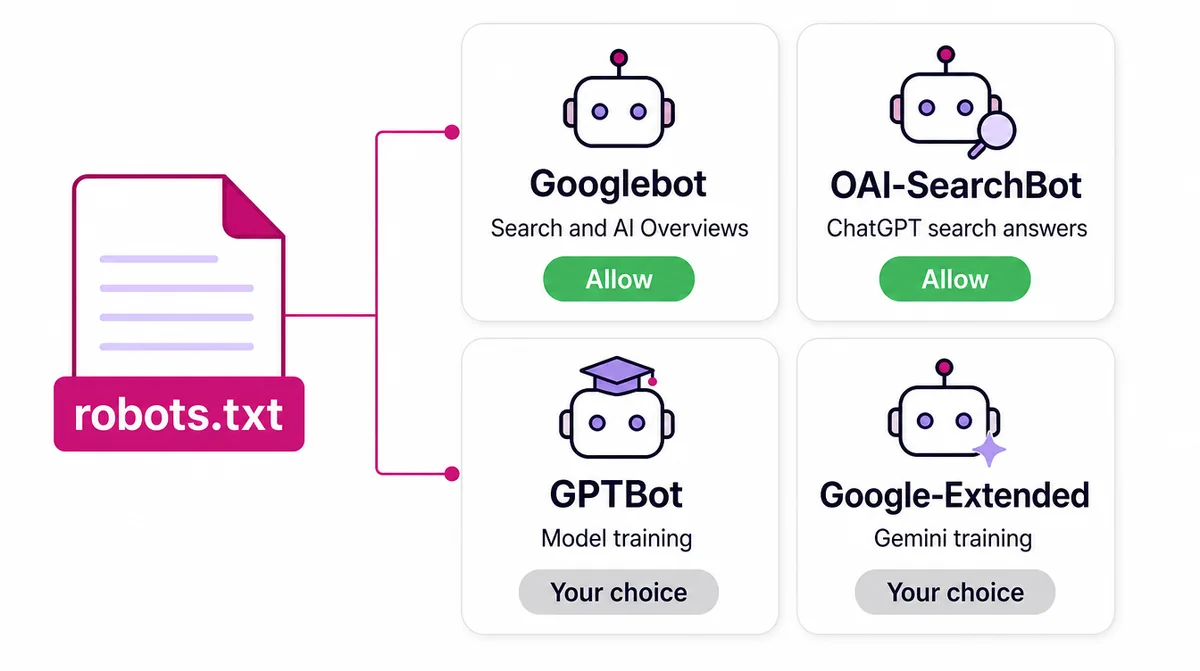
Assistants can only use pages their crawlers are allowed to read. Your robots.txt file controls that, and the different crawlers do different jobs, so the choice is not all or nothing.
| Crawler | What it is for | If you block it |
|---|---|---|
| Googlebot | Google Search, including AI Overviews | You disappear from Google. Never block it |
| OAI-SearchBot | Showing websites in ChatGPT search answers | OpenAI says your site will not be shown in ChatGPT search answers |
| GPTBot | Training OpenAI’s models | Your content is not used for training; search answers are unaffected |
| Google-Extended | Training future Gemini models and grounding in Gemini apps | Google says it does not affect inclusion or ranking in Google Search |
| PerplexityBot, ClaudeBot | Those assistants’ own indexes | Less chance of being cited by them |
For most small businesses the sensible default is to allow them all, because being quotable is the point. Our own robots.txt welcomes the AI crawlers for exactly that reason. If you have a specific reason to keep content out of model training, block the training crawlers and leave the search ones open.
Step 3: be a clearly defined business
An assistant has to be sure which business it is talking about before it will name it. That is harder than it sounds when your name is spelled three ways, your address differs between Google and Facebook, and two of your phone numbers no longer work.
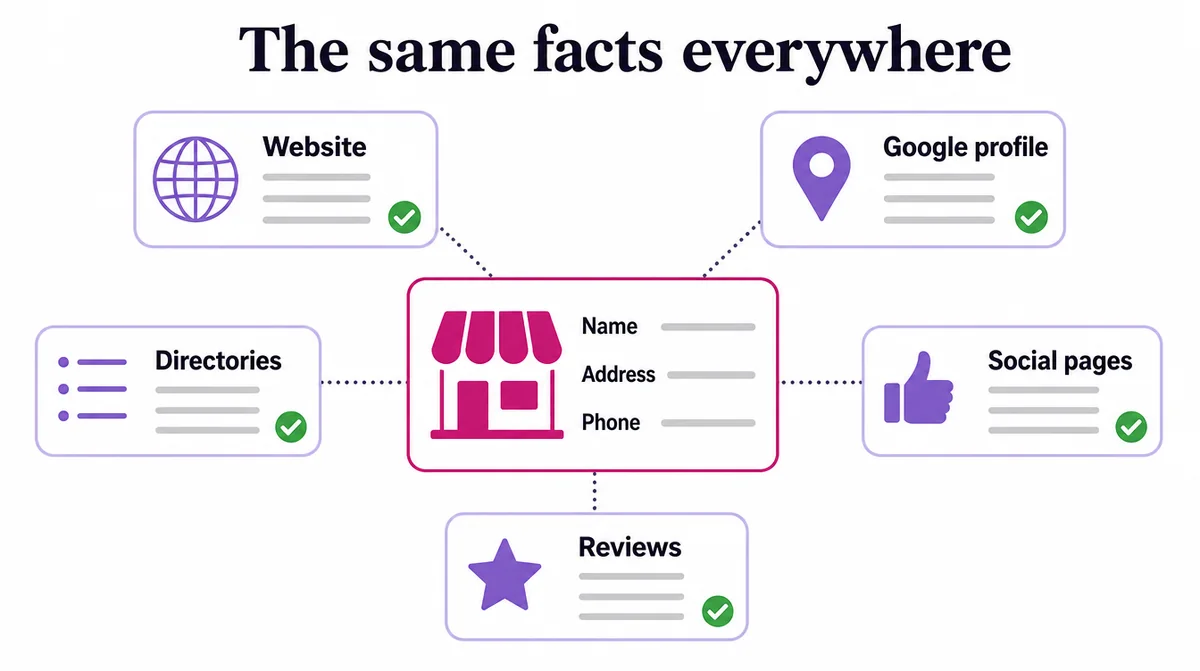
| Fact | Make it identical on |
|---|---|
| Business name | Website, Google Business Profile, Facebook, Instagram, LinkedIn, directories |
| Address and area served | Website footer, contact page, profile, directories |
| Phone and WhatsApp | Everywhere, and make sure they are answered |
| What you do, in one sentence | Homepage, About page, profile description, social bios |
| Prices or starting prices | Your service pages, and anywhere else you list them |
Then describe yourself for machines as well as people. Organisation or LocalBusiness structured data on your site, with links to your official profiles, tells every system exactly who you are. It must match what the page visibly says.
Step 4: write pages an assistant can quote
Assistants lift sentences. The easier your page is to quote accurately, the more likely it is to be used. In practice that means answering the question in the first two sentences, then giving the detail.
| Hard to quote | Easy to quote |
|---|---|
| “We are passionate about delivering excellence in every project.” | “We build six-page business websites in Cameroon for 250,000 FCFA, including a year of hosting.” |
| “Results may vary depending on many factors.” | “Technical fixes usually show in two to six weeks; competitive searches take six months or more.” |
| A long introduction before the answer | The answer first, then why, then how |
| Claims with nothing behind them | Numbers, a named source, a real example |
- Use question-shaped headings that match how people ask
- Put prices, timescales and quantities on the page
- Add a short FAQ with direct answers
- Use tables for comparisons; they are easy to lift accurately
- Cite your sources, as the research suggests
- Write in the language your customers ask in, including French
Step 5: get mentioned somewhere other than your own site
An assistant that finds you only on your own website has one source to go on. One that finds you on your site, your Google profile, two directories, a news article and a partner’s page has corroboration. That is the GEO version of authority, and for a local business it comes from ordinary places.
- Accurate listings on the directories people here actually use
- Suppliers, partners and clients who list the businesses they work with
- Trade associations and professional bodies
- Local news coverage of something genuinely newsworthy
- Reviews that describe your service in customers’ own words
Reviews matter twice: for the map results and for AI answers. Our post on getting more Google reviews covers doing it within the rules.
Step 6: measure it honestly
There is no Search Console for ChatGPT. The reliable way to measure GEO is to ask the questions your customers ask, the same way, every month, and record what happens.
| Record | How |
|---|---|
| The questions | Eight to twelve real buying questions, in English and French, for example “best bakery in Bastos” |
| The assistants | ChatGPT, Gemini, Perplexity, and Google’s AI Overviews |
| Named or not | Whether your business appears, and in what position |
| Described correctly | Whether the facts about you are right |
| Who is named instead | The competitors the assistants prefer, and what their pages do differently |
Answers vary from one try to the next, so judge the trend over several months rather than one screenshot. And keep watching the numbers that pay the bills: enquiries, and where they say they found you.
What not to do
- Do not stuff keywords. The GEO study found it made visibility slightly worse
- Do not mass-produce AI pages for every town and service. Google treats pages made mainly to manipulate rankings as spam
- Do not buy fake reviews or mentions. They break Google’s policies and are easy for systems to discount
- Do not chase a special AI file before the basics. Google says none is needed for its AI features
- Do not block the search crawlers you want to be found by
A 90-day GEO plan
| Days | Do this |
|---|---|
| 1 to 30 | Run the monthly check to get a baseline. Fix indexing and speed. Make your name, address, phone and description identical everywhere |
| 31 to 60 | Rewrite your main service pages to answer first, with prices, timescales and a short FAQ. Add structured data that matches |
| 61 to 90 | Earn three or four genuine mentions: directories, partners, an association. Keep collecting reviews. Run the check again and compare |
We will not promise that any assistant will name you by a certain date, because nobody controls what they say. What reliably improves your chances is being the clearest, most consistent, best-corroborated answer to the question.
What it costs to have it done
GEO is part of our search work rather than a separate trick, and it is included in our Market Dominance SEO plan at 450,000 FCFA a month. Every engagement starts with the free SEO and AI visibility audit, which shows what the assistants say about you today. Our GEO service page explains the work in detail, and SEO pricing lists every plan.
Go further: the SEO guide, our SEO and GEO service, SEO prices, or local SEO and Google Business Profile.
Questions people ask
SEO aims to rank your pages in a list of search results. GEO aims to get your business named inside the answers AI assistants give, such as ChatGPT, Gemini, Perplexity and Google's AI Overviews. GEO builds on SEO rather than replacing it.
For Google's AI Overviews, Google says good SEO is all that is required. For other assistants, the extra work is making your business details consistent across the web and writing pages that are easy to quote.
No. There is no way to buy a mention in an assistant's answer. The work is making true, consistent information about your business easy to find and verify.
Not if you want to be named. OpenAI says sites that block OAI-SearchBot will not be shown in ChatGPT search answers. Training crawlers such as GPTBot and Google-Extended can be blocked without affecting search, if you prefer.
Google says no new AI text files are needed to appear in its AI features. Get the basics right first: indexed pages, clear answers and consistent facts.
Usually months rather than weeks, and it varies by assistant. Fixing inconsistent business details can be picked up relatively quickly; earning mentions elsewhere takes longer.
Ask it the questions your customers would ask, in English and French, and record the answers every month. Check Gemini, Perplexity and Google's AI Overviews the same way.
Yes, where your customers ask in French. Assistants answer in the language of the question and draw on sources in that language, so French pages give you a better chance with French questions.




Comments
No comments yet.Be the first to add one. We read every comment and reply to the ones that ask something real.
Leave a comment
Thank you. It will appear once we have read it, usually the same working day.