

eCommerce and online stores
eCommerce websites and online stores that take MTN MoMo and Orange Money.
Selling online here fails at the checkout more often than anywhere else. A store that only takes cards asks most Cameroonian customers to give up at the last step. We build stores that take the money the way your customers actually hold it.

The checkout is where stores are won or lost.
Everything before the checkout is easy to get right. The moment that decides whether you made a sale is the one where a customer has chosen a product and has to pay. If mobile money is not there, most of them stop.
Cards are not the payment method to build around here. Your customer is on a phone, holding a MoMo or Orange Money balance, and a checkout asking for a card number is asking them to go and find one. So we build the payment step first, and put every gateway through real transactions before launch rather than after the first complaint.
MTN MoMo and Orange Money at checkout
The two payment methods most of your customers already use, working properly rather than as an afterthought.
WooCommerce or Shopify, whichever fits
We will tell you which suits your catalogue and your team, and why, before you commit to either.
Stock that matches the shelf
Quantities update as orders come in, so you stop selling things you ran out of last week.
Delivery that reflects real distances
Rates by town or zone, so a delivery across Douala does not cost the same as one across the country.
Product pages built to be found
Each product written and structured for what people type when they are ready to buy it.
A dashboard your team can run
Add products, change prices and check orders without calling us or waiting until Monday.
What is included
What an online store includes.
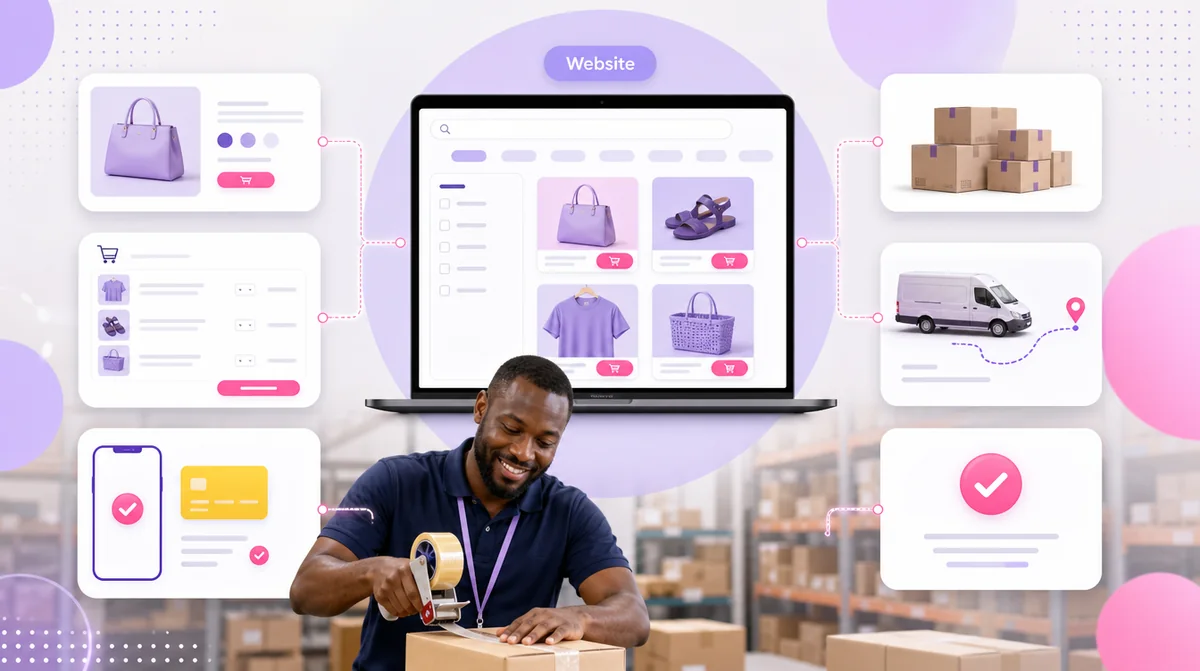
An online store is a web design project plus the parts that handle money, stock and delivery. Those parts are where the work is, and where most cheap stores quietly break.
Store build and setup
Catalogue structure, product pages, categories and the search and filters people need to find things.
Local payment gateways
MTN Mobile Money and Orange Money, plus card and bank transfer if you want them, tested with real transactions.
Stock and order management
Inventory, order statuses and the emails that tell a customer what is happening without you typing them.
Delivery and pickup options
Zones, rates and pickup, set up the way your business actually delivers.
Product SEO
Titles, descriptions and product schema, so your items can appear in search results with price and availability.
Training and handover
Your team is shown how to run the store, and the logins are yours from day one.
How we work
Four steps from catalogue to first order.
Plan
We go through your catalogue, your delivery areas and how you want to be paid before anything is built.
Build
The store, the product pages and the checkout, on WooCommerce or Shopify.
Test
Real test transactions on MoMo and Orange Money, on a phone, before anyone else sees the store.
Hand over
Training for your team, every login in your name, and support while the first orders come in.
Pricing
eCommerce builds start at 600,000 FCFA.
An online store sits in the Enterprise plan because of the payment, stock and delivery work involved. The full price list is published, and we quote in writing before anything starts.
Questions
The things people ask first.
An eCommerce website is an online store that takes orders and payments without a phone call. Here that means MTN Mobile Money and Orange Money at the checkout, stock counts that stay accurate as orders arrive, and delivery zones that match what it actually costs to send something across town.
Yes. It is the part most stores here get wrong or skip. We set up the gateway, connect it to your merchant account, and put real transactions through it before launch so you know it works.
WooCommerce if you want to own everything and avoid a monthly platform fee, which suits most businesses here. Shopify if you want less to maintain and are comfortable paying monthly for that. We will recommend one and explain why.
There is no practical limit. What changes with a large catalogue is the work of organising it, so a store with 2,000 products needs more planning than one with 30. We quote on the catalogue you actually have.
That is the normal case here. Stock can be updated from the dashboard by whoever is in the shop, so the site does not sell what you handed over the counter an hour ago.
Four to eight weeks, depending on how quickly product information and photographs come back. The catalogue is almost always the slowest part, and it is the part only you can supply.
The mobile money operator and your bank set those, and they come out of each sale. They are not our fees. We will show you what they are before you choose a gateway, because they affect your pricing.
Next step
Tell us the goal. We will come back with the plan.
No pressure and no obligation. Start with the free audit, or send us a brief and get scope, timeline and cost in writing.
