

SEO, explained
How search actually works, and what moves a Cameroonian business up it.
A working guide to getting found on Google and in AI answers here: how search works, the three parts of SEO, local search, the pages that rank, technical health, links, GEO, what it costs, how long it takes, and how to tell whether the money is doing anything.

Being on Google and being found are different things.
Almost every business we speak to is already on Google. Type the business name and there it is. The problem is that nobody searches for a business name they do not know yet, and for the searches that actually matter, the ones describing the problem you solve, the business is nowhere.
SEO is the work of closing that gap. It is unglamorous, it is slow, and it is the cheapest customer acquisition most small businesses will ever have, because once a page ranks it keeps working without a daily budget behind it.
It is also the area with the most nonsense attached to it. This guide is what we would tell a client over a coffee: what the work is, what it is not, and how to judge whether the person doing it is any good.
 By Nyah Eliud, Founder & Chief Strategist
Updated 20 October 2026
14 min read
Key takeaways
- SEO has three parts: technical, content and authority. Find the one that is failing before spending money on the others.
- The three map results are decided by relevance, distance and prominence. Your Google Business Profile and your reviews are the fastest win available.
- Build one page per service that answers its search in the first paragraph, in the words customers use, in French and English.
- Google says its AI Overviews need no special optimisation: good SEO is the base, and GEO extends it to ChatGPT, Gemini and the rest.
- Expect weeks for technical fixes and six months or more for competitive searches, and judge the work on enquiries, not impressions.
How Google decides what to show
Google describes its own process in three stages: crawling, indexing and serving results. A program called Googlebot follows links from page to page and downloads what it finds. Google then tries to understand each page and stores it in its index. When somebody searches, it pulls the pages from that index it judges most useful and puts them in order.
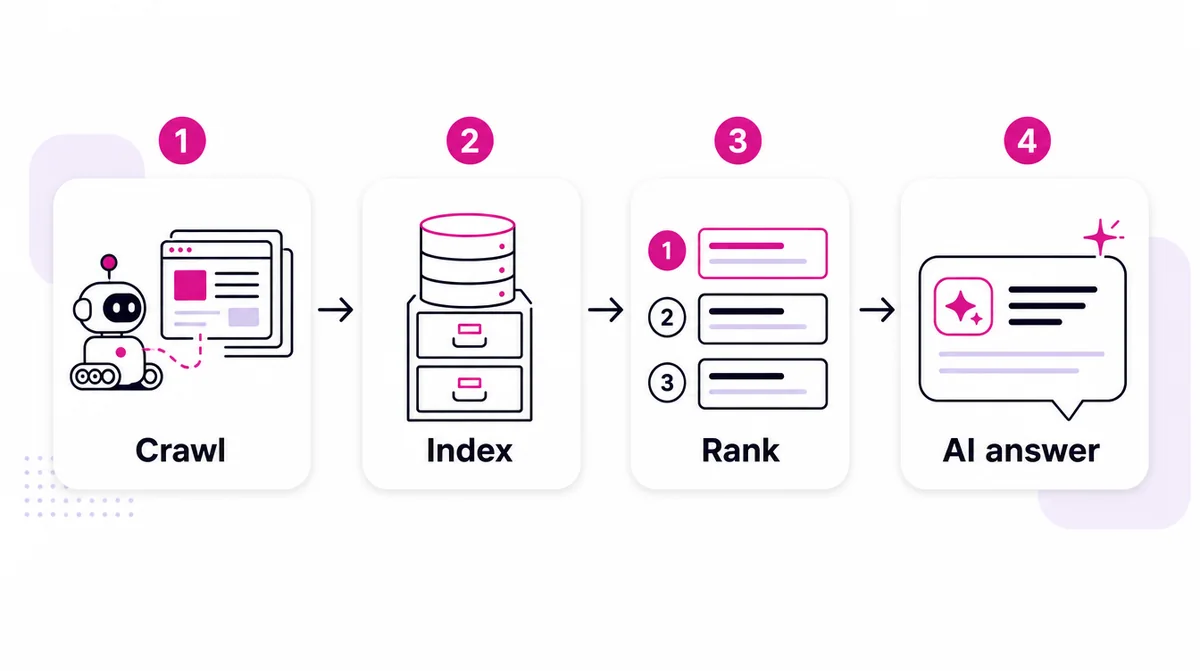
Since 2024 there is a fourth layer on many searches: an AI Overview written above the ordinary results. It is built from the same index. Google says plainly that there are no extra requirements and no special tricks to appear in it. A page has to be indexed and eligible to show a normal snippet, and that is all.
This matters because each stage fails in a different way, and the fix for each is different. A page Google cannot crawl needs a technical fix. A page that is indexed but ranks for nothing needs better content. A good page stuck on page two usually needs more sites vouching for it.
Check where you stand in two minutesSearch site:yourdomain.com on Google. The pages listed are the ones in the index. If an important page is missing, nothing else in this guide will help it until that is fixed.
The three parts of SEO, and finding the one that is failing
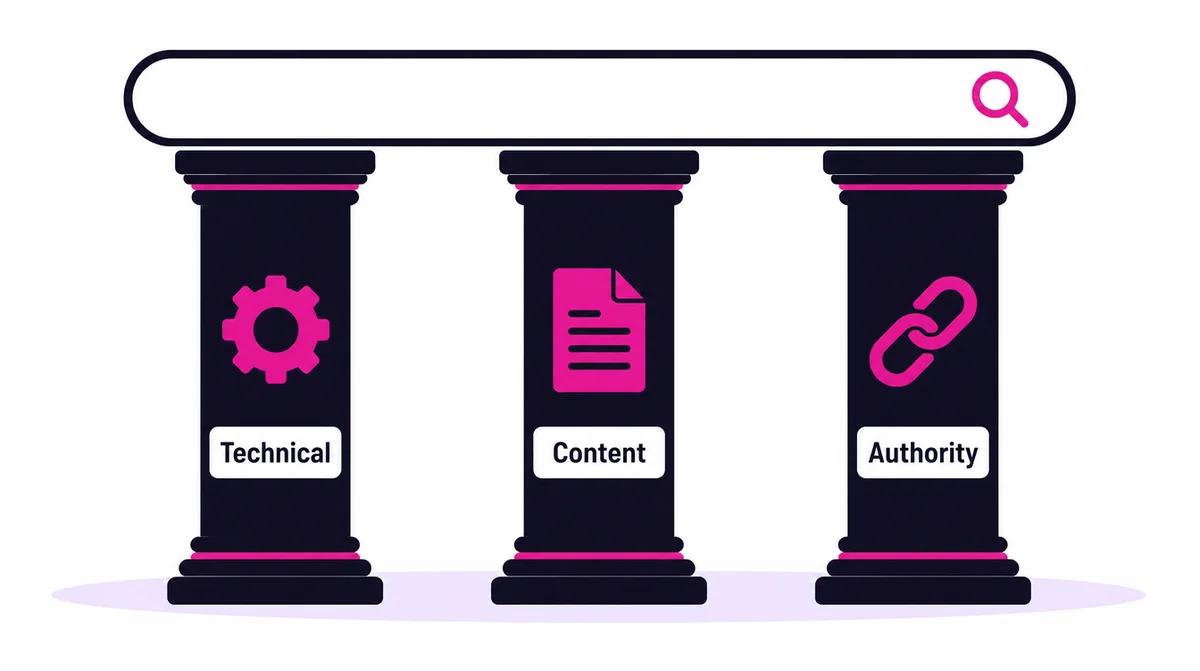
Search work divides into three. Technical: can Google reach, read and load your pages. Content: do those pages answer what people are actually searching for. Authority: do other sites vouch for you by linking to you and talking about you. Every stalled SEO project is stuck on one of the three, and the first job is finding out which.
| Part | What it means | Signs it is the problem | First fix | How fast it moves |
|---|---|---|---|---|
| Technical | Google can reach, read and load your pages quickly | Pages missing from Google, slow on a phone, several versions of the same page | Fix indexing and speed issues flagged in Search Console | Weeks |
| Content | Your pages answer what people search for | Indexed, but ranking for nothing useful; visitors leave at once | One page per service, with the answer in the first paragraph | Two to three months |
| Authority | Other sites link to you and mention you | Good pages stuck on page two behind weaker ones | Listings, partners, associations and local press | Six months and more |
Technical problems are the quickest to fix and the most commonly ignored. Content problems take longer but are entirely within your control. Authority is the slowest, and the one nobody can shortcut honestly.
Finding the searches worth winning
You do not need an expensive tool to start. Type the obvious phrase for what you sell into Google and read the suggestions that drop down. Open the “People also ask” box. Scroll to the related searches at the bottom. That is keyword research, straight from the people you are trying to reach. Once your site is live, Search Console shows the exact searches that already bring you visitors, which is the most valuable list of all.
Match the page to what the searcher wants
Every search has an intent behind it, and the page that wins is the one built for that intent. A list of services will not rank for a question, and a long article will not rank for somebody ready to buy.
| Intent | What the searcher wants | A search like this here | The page that wins |
|---|---|---|---|
| Informational | To understand something | how to register a business in Cameroon | A clear guide or article |
| Commercial | To compare before choosing | WooCommerce or Shopify for Cameroon | A comparison, case studies, prices |
| Transactional | To buy or book now | buy solar panels Yaoundé | A product or service page with a price and a contact button |
| Local | A business nearby, today | pharmacie de garde Bastos | Your Google Business Profile, then a location page |
Research in both languages. A large share of searches here are typed in French, often by the same customers who would read your English site, and the French phrase is frequently the one with less competition.
- Choose searches you can genuinely answer best. Ranking for a phrase you cannot serve brings visitors who leave.
- Do not chase volume alone. Tools often show zero searches for local phrases that still bring paying customers every week.
- Start narrow. “Web design Douala” is winnable long before “web design” is.
- Write down one main search per page. If two pages target the same search, they compete with each other.
Local search is a separate game, with separate rules
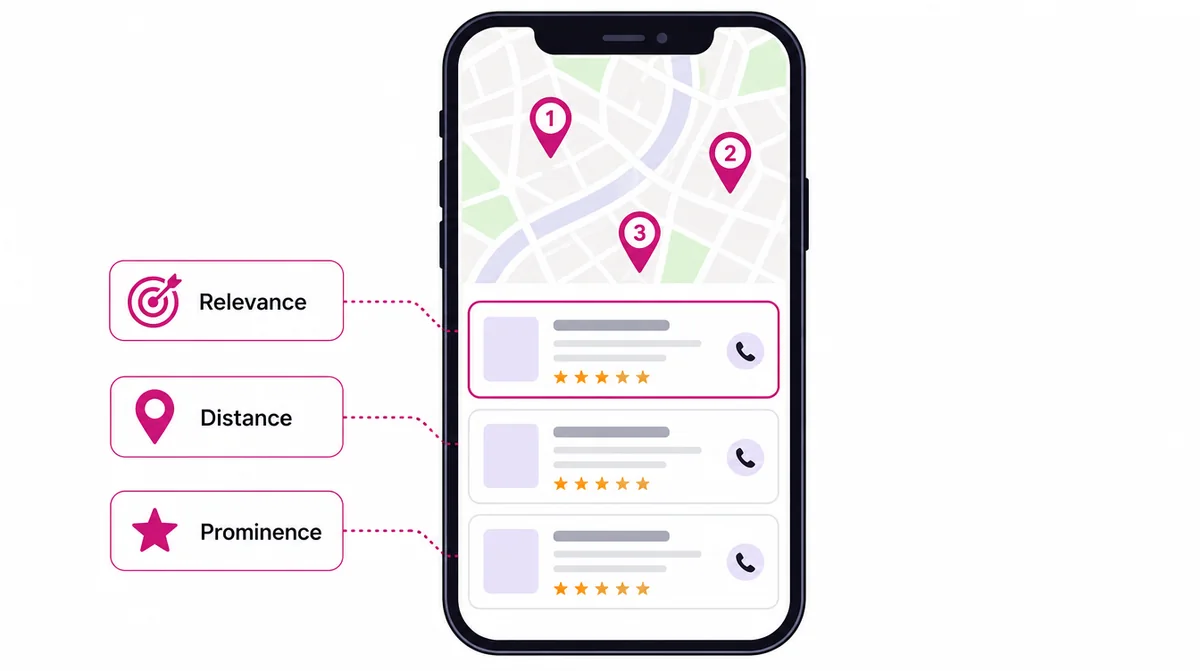
When somebody searches with local intent, Google shows a map with three businesses above the ordinary results. Most people never scroll past it. Getting into those three has almost nothing to do with the work that ranks a page nationally, which is why businesses paying for SEO are sometimes still invisible to the customer standing two streets away.
Google says local results are based mainly on three things. Relevance: how well your Business Profile matches the search. Distance: how far you are from the person searching. Prominence: how well known you are, judged partly by links to your site and by your reviews. You cannot move your premises. The other two are entirely in your hands.
A Google Business Profile checklist
- Claim and verify the profile, and make sure you, not a former supplier, own it
- Use your real business name, exactly as customers see it on your sign. Adding keywords to the name breaks Google’s guidelines and can get the listing suspended
- Pick the most specific primary category available, then add secondary ones
- Opening hours, including public holidays, kept up to date
- Real photos of the premises, the team and the work, not stock images
- Every service or product listed, with prices where you can
- A reply to every review, good or bad, within a few days
- The same name, address and phone number everywhere you are listed
For a shop, a clinic, a garage or a restaurant this is usually the fastest result available anywhere in marketing. A profile that was never claimed can move within weeks, and it costs nothing but an afternoon.
The easiest way to get more reviewsAsk in person at the moment the customer is happy, then send the review link on WhatsApp the same day. Most people who intend to leave a review never do because nobody made it easy.
Write for the search, not for the keyword
The mistake that wastes the most money is building a page around a phrase instead of around a question. Somebody typing “how much does a website cost in Cameroon” wants a number and a range. If your page repeats the phrase eleven times and never gives a figure, it will not hold a ranking, because everybody who lands on it goes straight back to the results.
- One page per thing you sell, never one page listing everything
- Answer the question in the first paragraph, then explain it
- Use the words your customers use, not the words your industry uses
- Include the specifics only you can give: prices, timescales, local detail
- Write the page you would want to find if you were the one searching
The on-page elements that matter
| Element | What good looks like | Example |
|---|---|---|
| Title | The search, plus one reason to choose you, in roughly 50 to 60 characters | Web Design in Douala | Sites from 80,000 FCFA |
| Meta description | Two lines that answer the search and invite the click. Google may rewrite it | Mobile-first business websites with mobile money checkout, built and hosted in Cameroon. |
| Main heading (H1) | One per page, saying plainly what the page is | Web design for businesses in Douala |
| Address (URL) | Short and readable, words rather than numbers | /web-design-douala |
| Images | Compressed, in WebP, with alt text describing the picture | A bakery owner taking a mobile money payment at the counter |
| Internal links | Links to related pages using words that describe them | “see our SEO prices”, never “click here” |
The step-by-step version of this, from choosing the searches to structuring the pages, is in how to rank a small business website in Cameroon.
Technical health: the checks that decide whether content gets a chance
You do not need to be a developer to understand technical SEO, but you do need somebody to check it, because a technical fault can quietly cancel every other piece of work.
The first rule is that Google ranks the phone version of your site. It indexes and ranks using what its smartphone crawler sees, so a site that looks fine on a laptop and breaks on a phone is broken as far as Google is concerned. In a market where most people browse on mobile data, that is also how your customers see it.
Core Web Vitals: the speed measures Google publishes
| Measure | What it checks | Good score | What usually breaks it here |
|---|---|---|---|
| Largest Contentful Paint (LCP) | How quickly the main content appears | 2.5 seconds or less | Huge uncompressed photos, overloaded cheap hosting |
| Interaction to Next Paint (INP) | How quickly the page reacts to a tap | 200 milliseconds or less | Too many plugins and third-party scripts |
| Cumulative Layout Shift (CLS) | How much the page jumps while loading | 0.1 or less | Images without set sizes, banners that load late |
- HTTPS everywhere, with the padlock on every page
- One version of the site. The www and non-www addresses, and http and https, should all lead to the same place
- An XML sitemap submitted in Search Console
- Nothing important blocked by robots.txt or a noindex tag, which happens more often than you would think after a redesign
- Structured data describing your business, your articles and your FAQs, matching what is visible on the page
- No broken links or pages that redirect in a chain
If speed is your problem, why your WordPress site is slow walks through the five usual causes in the order worth checking them.
Authority: earning links without buying them
Links from other websites are still one of the ways Google judges how prominent and trustworthy a business is. Its own local ranking advice names links and reviews as part of prominence. That is exactly why people sell them, and why buying links for ranking is listed among Google’s spam policies.
Honest links come from real relationships and from having something worth pointing to. For a business in Cameroon, the useful sources are usually close to home.
- Suppliers, distributors and partners who list the businesses they work with
- Trade associations, chambers of commerce and professional bodies you belong to
- Local news coverage of something genuinely newsworthy: an opening, a hire, a community project
- The few directories real customers actually use, kept accurate
- Useful guides, price lists or data that other sites want to cite
- Events, schools and sports clubs you sponsor
If somebody offers you 500 backlinks for 20,000 FCFADecline. At best the links are worthless. At worst they are exactly what Google’s link spam policy describes, and the cost arrives months later as a ranking you cannot explain.
SEO and AI search: where GEO fits
A growing share of research now starts with an AI assistant rather than a search box. Google’s AI Overviews, ChatGPT, Gemini, Perplexity and Claude all answer the question directly and name a few businesses in the answer.
For Google’s own AI features the answer is reassuringly simple. Google says no special optimisation is needed: the same SEO that gets a page indexed and eligible for a normal result is what makes it eligible for an AI Overview. Good SEO is the foundation.
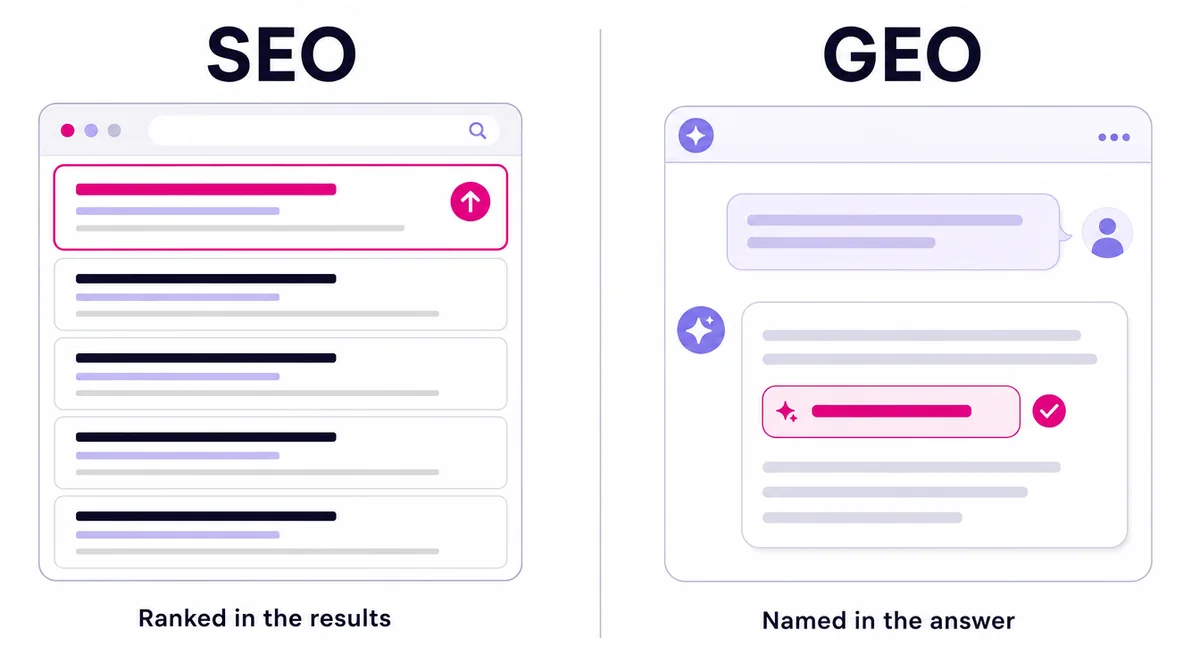
The other assistants build their answers from the wider web: your website, your profiles, directories, reviews and what other sites say about you. Generative engine optimisation, or GEO, is the work of making that information complete, consistent and easy for a machine to read, so an assistant can identify your business and has a reason to name it.
| SEO | GEO | |
|---|---|---|
| Goal | Rank in the list of results | Be named in the answer |
| Where | Google and Bing results | ChatGPT, Gemini, Perplexity, Claude and Google’s AI Overviews |
| What it reads | Your pages and the links pointing to them | Your pages, profiles, directories, reviews and mentions |
| Measured by | Rankings, clicks and enquiries | How often, and how accurately, you are named |
| Depends on | A healthy, well-structured site | Good SEO first, then consistency everywhere else |
Our GEO service page explains how we work on it, and getting your business mentioned by AI assistants covers the parts you can start yourself.
Ranking is not the finish line
Businesses celebrate a ranking and then wonder why the phone stays quiet. Showing up on the results page and being chosen from it are two different problems, and only the second one earns anything.
Your search result is an advert you did not pay for: a headline, two lines of text, and about two seconds to beat five competitors sitting directly above and below it. Most businesses never write it deliberately at all, and let Google assemble something out of whatever text it finds on the page.
A title that earns the click answers the search and adds one reason to pick you: a price, a place, a timescale, or something a competitor cannot say. “Hotel in Douala” is a label. “Hotel in Douala with instant online booking” is an argument.
Why nobody clicks your result covers writing titles and descriptions properly, and what a modern results page does to your visibility even in first place.
How long it takes, honestly
Anyone promising page one in thirty days is lucky, lying, or using tactics that will cost you the site later. The last of those is the one to worry about, because the damage arrives long after the invoice is paid. These are the timescales we see in practice. They are typical, not promises.
| Work done | When movement usually shows |
|---|---|
| Technical fixes: indexing, speed, mobile | Two to six weeks |
| Google Business Profile completed and reviews flowing | Two to eight weeks |
| New pages on a young site | Two to three months |
| Competitive commercial searches | Six months or more |
| Being named by AI assistants | Three months or more, and it varies from one assistant to the next |
Cameroon does have a genuine advantage: competition is low. Plenty of businesses that ought to rank have thin sites and no strategy at all, so results arrive faster here than they would in a saturated market. That window will close, which is an argument for starting now rather than a reason to expect miracles.
What SEO costs, and what the money buys
These are our published prices. Whoever you hire, the useful question is what the fee actually buys, because the same monthly figure can mean a full programme of work or a single automated report.
| Option | Price | Best for | What it covers |
|---|---|---|---|
| Do it yourself | Your time | One location, simple services | Business Profile, reviews, basic on-page work, this guide |
| Local SEO setup | 100,000 FCFA once | Getting the foundations right without a retainer | The Local SEO work, done once |
| Local SEO | 75,000 FCFA a month | A business serving one city | Business Profile optimisation, map pack setup, on-page basics, schema, a monthly report |
| Growth SEO | 200,000 FCFA a month | Businesses reaching the whole country | Full technical fixes, competitor research, two to four articles a month, conversion work |
| Market Dominance | 450,000 FCFA a month | Competitive niches and online stores | Full audits, eight or more articles a month, product pages, GEO, weekly calls |
Before you pay anybody, including us, ask these:
- How many hours a month, and spent on what?
- Who writes the content, and is it included or extra?
- What is the minimum term, and what happens at the end of it?
- Which reports do I get, and will they say what changed?
- Do I keep the work if we stop, including the pages and the accounts?
The last one matters more than people expect. Work done in accounts you do not own is work you are renting. Full plan details are on our SEO pricing page.
Hiring somebody, without being sold to
SEO is unusually easy to sell badly, because the results are slow enough that a bad supplier can take money for months before anybody can prove it is not working.
The strongest signal is what somebody says they cannot do. A provider who tells you a keyword is not worth chasing, or that your site needs fixing before any content is written, is describing the job accurately. A provider who guarantees rankings is describing something nobody controls.
The full list of questions worth asking, and the answers that should worry you, is in eight questions to ask before hiring an SEO agency.
The guarantee that is not a guaranteeNobody sells rankings, including Google. What an honest provider can commit to is the work, the reporting, and telling you plainly when something is not working.
How to tell whether it is working
Rankings are a means, not a result. The report that matters shows what changed, why it changed, and what happened to the numbers you care about: enquiries, calls, form submissions, orders.
| What to track | Where to find it | Why it matters |
|---|---|---|
| Pages in Google’s index | Search Console, Pages report | Nothing ranks if it is not indexed |
| Searches and clicks | Search Console, Performance report | Shows which searches actually bring people |
| Calls, direction requests, website clicks | Google Business Profile performance | Local visibility turning into contact |
| Enquiries and sales from search | Google Analytics key events, or your own records | The only number that pays the bills |
| Mentions in AI answers | The same set of questions, asked every month | Whether GEO work is moving |
A monthly report leading with impressions is leading with its most flattering number. Ask instead which searches brought people who actually did something, how many of them there were, and what was changed last month that caused it.
Give it a quarter before judging. One month of SEO data is mostly noise, and reacting to noise is how businesses end up changing direction every eight weeks and never ranking for anything.
A 90-day plan to start with
If you are starting from nothing, this order gets the fastest results first and avoids writing content for a site Google cannot read.
- Days 1 to 7. Set up Search Console, check what Google has indexed, and claim or finish your Google Business Profile.
- Days 8 to 30. Fix the technical basics: speed, mobile, one version of the site, a sitemap. List the searches you want to win, one per service, in French and English.
- Days 31 to 60. Build or rewrite one page per service, each answering its search in the first paragraph, with a proper title and description. Ask every happy customer for a review.
- Days 61 to 90. Earn your first honest links from partners and associations, publish one genuinely useful guide, then compare Search Console and your enquiries with day one and plan the next quarter.
If you would rather hand any part of this over, start with the free SEO and AI visibility audit. It shows where you stand today, in writing, without a call.
Where this comes from
The primary sources behind the claims above. Each one is worth reading in full if you want the detail.
- Google Search Central — In-depth guide to how Google Search works
- Google Search Central — AI features and your website
- Google Search Central — Mobile site and mobile-first indexing best practices
- web.dev — Web Vitals, including the Core Web Vitals thresholds
- Google Business Profile Help — Tips to improve your local ranking on Google
- Google Business Profile Help — Guidelines for representing your business on Google
- Google Search Central — Spam policies for Google web search, including link spam
- Google Search Central — Influencing your title links in search results
- Google Search Central — SEO Starter Guide





If you would rather not do it yourself
See our SEO service
If you would rather somebody ran this properly, our SEO retainers start at 75,000 FCFA a month and every report explains what changed and what it did.
Questions
The things people ask first.
SEO is the work of making a website appear when people search for what it sells. It has three parts: the technical health of the site, the content on its pages, and the links and mentions pointing at it from elsewhere. Unlike advertising, the results keep working after you stop paying.
Technical fixes can show in two to six weeks. Content on a newer site usually takes two to three months. Competitive commercial searches take six months or more. Competition here is lower than in bigger markets, so results tend to arrive faster, but nobody can honestly promise page one in thirty days.
Our retainers start at 75,000 FCFA a month, and a one-off local SEO setup is 100,000 FCFA. Growth SEO is 200,000 FCFA a month and Market Dominance 450,000. Whoever you hire, ask what the monthly fee buys in hours and deliverables, because the same price can mean a full programme of work or one report.
Yes, and for many businesses it matters more. Local SEO targets the three results Google shows on the map, which Google says are decided by relevance, distance and prominence. Your Google Business Profile and your reviews do most of the work, and it is usually faster than ranking a page.
SEO aims to rank your pages in the list of search results. GEO, generative engine optimisation, aims to get your business named inside the answers AI assistants give, such as ChatGPT, Gemini and Google's AI Overviews. GEO builds on SEO: for Google's AI features, good SEO is all that is required.
Ideally both, with a separate page for each language rather than both on one page. Many searches here are typed in French, often with less competition than the English phrase. Research the searches in both languages before deciding which to build first.
Yes. Google's own local ranking advice names links as part of how it judges prominence. What matters is where they come from: partners, associations and real coverage help, while bought links break Google's spam policies and can hold a site back.
Not to rank your service pages, but useful articles help in two ways: they win the informational searches people make before they are ready to buy, and they give other sites something worth linking to. One genuinely useful guide is worth more than ten thin posts.
The local part, largely yes: claiming your Business Profile, filling it in properly and collecting reviews is an afternoon of work and most of the benefit. Technical audits and competitive content are where it becomes a job. This guide and the articles under it cover the parts you can do alone.
Not always. We can run SEO on a site somebody else built. If the site is so slow or so badly structured that the budget would be wasted, we will tell you that before you spend it rather than after.
Next step
Tell us the goal. We will come back with the plan.
No pressure and no obligation. Start with the free audit, or send us a brief and get scope, timeline and cost in writing.
