

Social media, explained
Which platforms are worth your time in Cameroon, and how often to post.
A guide to running business social media here: why WhatsApp Business matters more than the rest, which platforms to choose, how often to post without burning out, what to post, how to answer messages and complaints, and how to tell whether any of it is working.

Two platforms done properly beats five done badly.
The advice most businesses receive is to be everywhere. It is bad advice, and it is why so many accounts here have three months of enthusiastic posting followed by two years of silence, which does more damage than never having started.
A social account is a promise that somebody is there. A page last posted to in 2023, with unanswered messages sitting in the inbox, tells a potential customer something specific about how you handle their business.
This guide is about picking the smallest number of platforms you can genuinely maintain, and running those properly.
 By Nyah Eliud, Founder & Chief Strategist
Updated 20 October 2026
8 min read
Key takeaways
- Set up WhatsApp Business properly first: catalogue, greeting and away messages, quick replies and labels.
- Choose two platforms where your customers already are, and run them well, rather than five badly.
- Post twice a week, planned a month at a time, rotating five types of post so you never run out.
- Answer every message within a working day. The reply is where attention turns into money.
- Judge social media on enquiries, not likes or followers.
WhatsApp Business is the one that matters most here
It is where enquiries arrive and where sales close, and it is the platform businesses here treat least seriously. Most run it on a personal account: no catalogue, no away message, no quick replies, and nobody else able to help when the owner is busy.
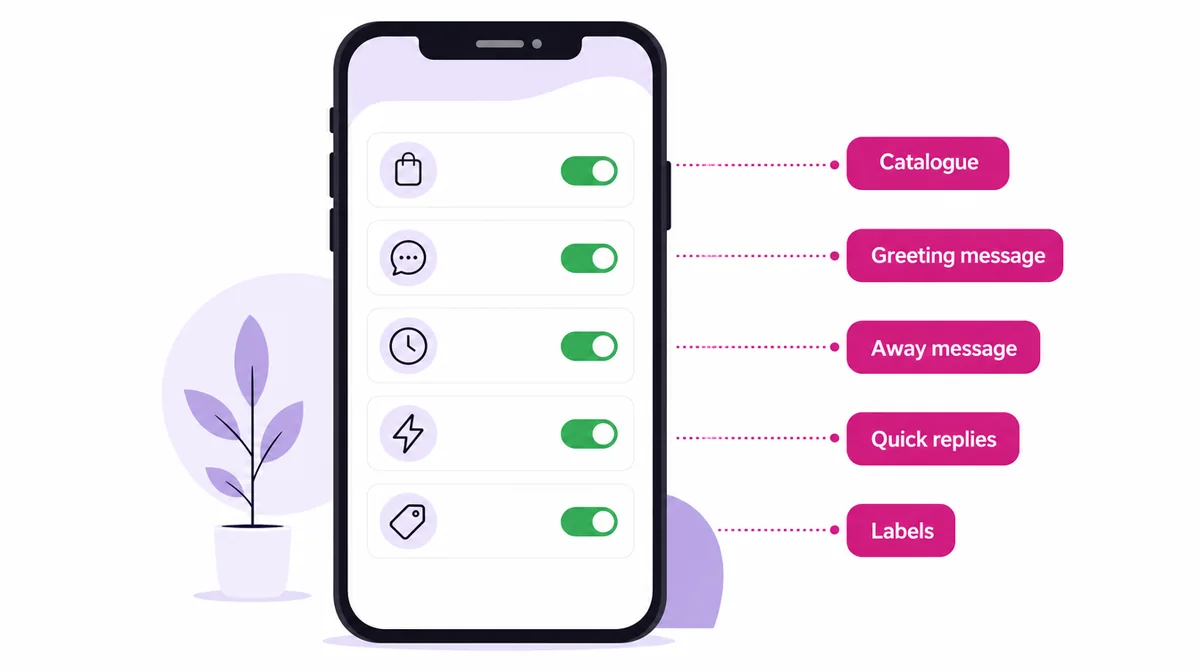
| Feature | What it does for you | Set it up so that |
|---|---|---|
| Catalogue | Customers browse products and prices without asking | Every product has a photo, a price and a one-line description |
| Greeting message | Answers a first-time contact instantly | It thanks them, says what you sell and links the catalogue |
| Away message | Covers the hours you are closed | It says when you will reply, so nobody waits in silence |
| Quick replies | Saves retyping the same answers | Prices, location, delivery and payment are one tap each |
| Labels | Sorts conversations by stage | New enquiry, waiting payment, to deliver, done |
WhatsApp Business is your most important channel here sets each of those up properly, including the catalogue almost nobody uses.
The cheapest improvement availableAn away message saying when you will reply, linking to your catalogue. It costs nothing, works overnight, and stops the silence that sends people to a competitor.
Pick platforms by where your customers already are
Choose two, three at the outside. The right two are wherever your customers already spend time, not wherever the newest opportunity is said to be. A platform you cannot maintain is worse than a platform you never joined.
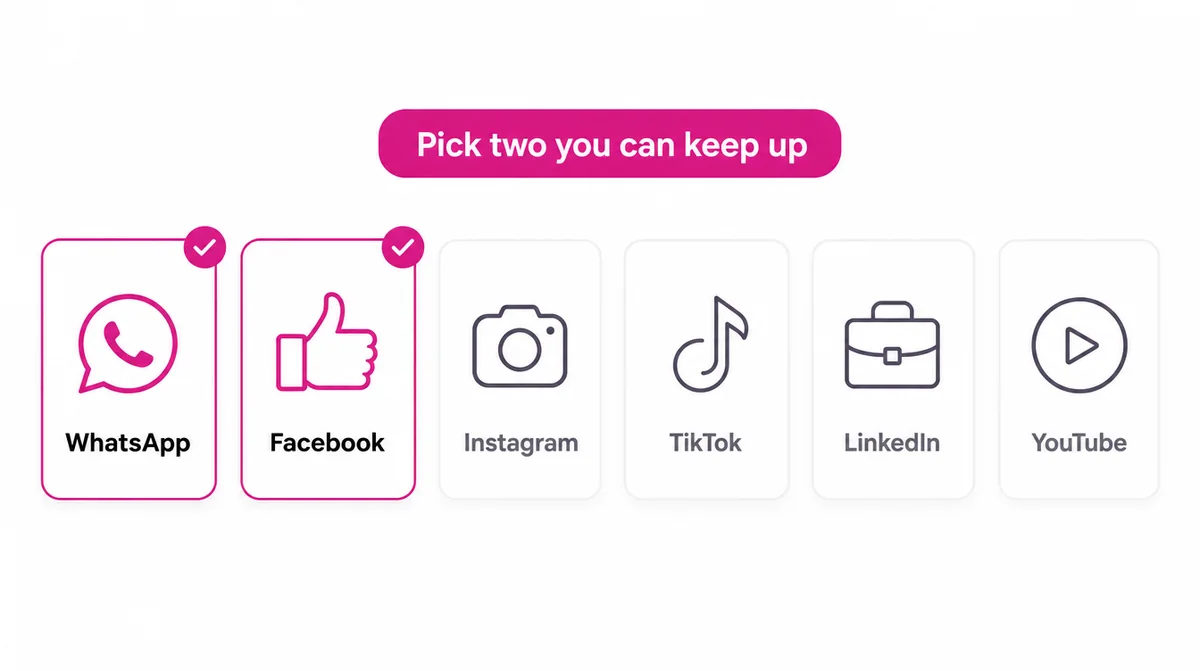
| Platform | Best for | What works there | Effort to do well |
|---|---|---|---|
| WhatsApp Business | Every business that takes enquiries | Fast replies, a catalogue, status updates | Low to set up, daily to answer |
| Local reach and buying conversations | Photos of real work, offers, events, reviews | Two posts a week | |
| Visual products: food, fashion, beauty, interiors | Strong photos, short vertical video | Medium, needs good visuals | |
| TikTok | Products that show well on video, younger buyers | Short, unpolished, informative video | High, needs regular video |
| Selling to organisations rather than people | Expertise, projects, people | Medium, writing-heavy | |
| YouTube | Explaining, demonstrating, how-to | Longer videos that answer real questions | High, but lasts for years |
Facebook has the reach here and remains where most local buying conversations happen. Instagram works when the product is visual. LinkedIn matters if you sell to organisations. TikTok rewards effort with reach faster than anything else right now, and demands a genuinely different kind of content.
Twice a week, forever, beats daily for a month
Consistency compounds and bursts do not. A business posting twice a week for a year has an audience and a habit. A business that posted daily for three weeks and then went quiet has taught everybody that it is not really there.
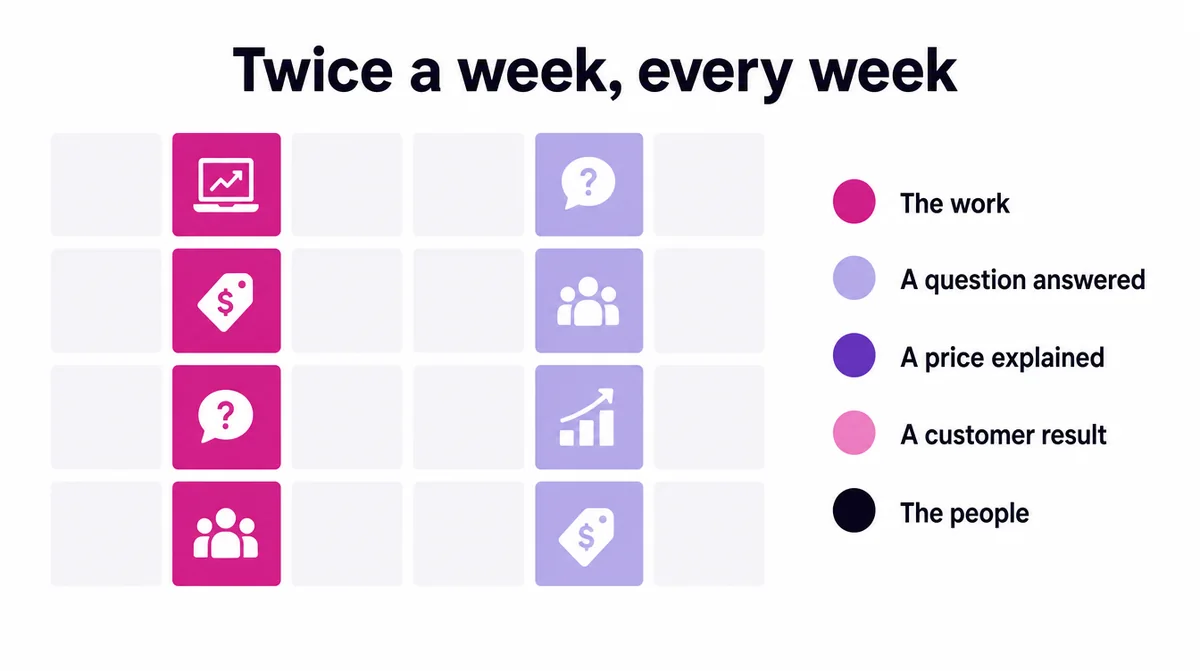
Plan a month at a time. Batch the work, keep a small bank of posts ready, and set a schedule you can keep in a busy month rather than a quiet one. Posting more is rarely the fix for a page that is not producing customers.
How often should your business post covers building that rhythm, and what to post when you think you have nothing to say.
What to actually post
The blank-page problem is what kills most schedules, and it is solved by having categories rather than ideas. Rotate through a handful and you will never open the month wondering what to say.
| Type | Why it works | Example for a bakery | Example for a garage |
|---|---|---|---|
| The work itself | Proof you do what you say | Wedding cake from sketch to table | Before and after of a respray |
| A question answered | Saves you answering it forty times | How far ahead should I order a cake? | How often should I change my oil? |
| A price explained | Filters out the wrong enquiries | What a three-tier cake costs and why | Why a service costs what it does |
| A customer result | Social proof, with permission | A client’s photo from the party | A taxi driver back on the road the same day |
| The people | Makes the business real | The baker at 5am | The mechanic who fixed it |
What almost never works is the motivational quote and the generic holiday graphic. They are easy to make, which is exactly why everybody has already seen them.
Video without a production budget
Every platform now favours short video, and most businesses here avoid it because they think it needs equipment. It does not. A phone held vertically, in daylight, with somebody explaining something useful, outperforms a polished advert on nearly every platform.
- Hook in the first two seconds. Show the result or ask the question first; the logo can wait
- Vertical, always. Phones are held upright, and sideways video wastes most of the screen
- Captions on. Many people watch without sound, on a bus or in an office
- Thirty to sixty seconds. Long enough to be useful, short enough to finish
- Daylight and a quiet room. Light and sound matter more than the camera
- One idea per video. How to choose, how it is made, what it costs, what went wrong
Record five in one session and post them over two weeks. The second video is always easier than the first, and by the fifth most people have stopped worrying about how they look on camera.
WhatsApp Status and community groups
Two of the most effective places to reach customers here are not on the usual list. WhatsApp Status is seen by everybody who has saved your number, which for a busy business is often more people than follow its Facebook page. Posting new stock, today’s offer or a finished job there costs nothing and reaches people who already know you.
Community groups, on Facebook and WhatsApp, are where neighbourhoods, alumni, parents and professions talk. Being genuinely useful in the right group, answering questions without selling, builds the kind of reputation advertising cannot buy. Posting adverts into groups uninvited does the opposite and gets you removed.
Ask before you addOnly add people to broadcast lists or groups if they asked to be there. Unwanted messages get your number reported and blocked, which is far harder to undo than to avoid.
Replying is the strategy, not the admin
Businesses plan content for weeks and leave messages unanswered for days. That is backwards. The reply is the part that turns attention into money, and it is the part a competitor most easily beats you at.
Set a rule everybody can follow: every message acknowledged within a working day, even if the answer is that you will come back tomorrow. Decide who does it when the owner is busy, and give them access. Most businesses here have exactly one person who can reply, which means enquiries stop whenever that person is on a job.
Comments count too. An unanswered question under a post is visible to everybody who reads it afterwards, and it is read as an answer.
Answer at night without being awakeAn automatic first reply that says it is automatic, gives your prices and hours, and promises a human answer in the morning keeps most enquiries alive until you are back.
Answer publicly, resolve privately
A public complaint is not an emergency, but silence turns it into one. Everybody reading is judging the reply rather than the complaint. A business that answers a bad review well usually looks better afterwards than one with no reviews at all.
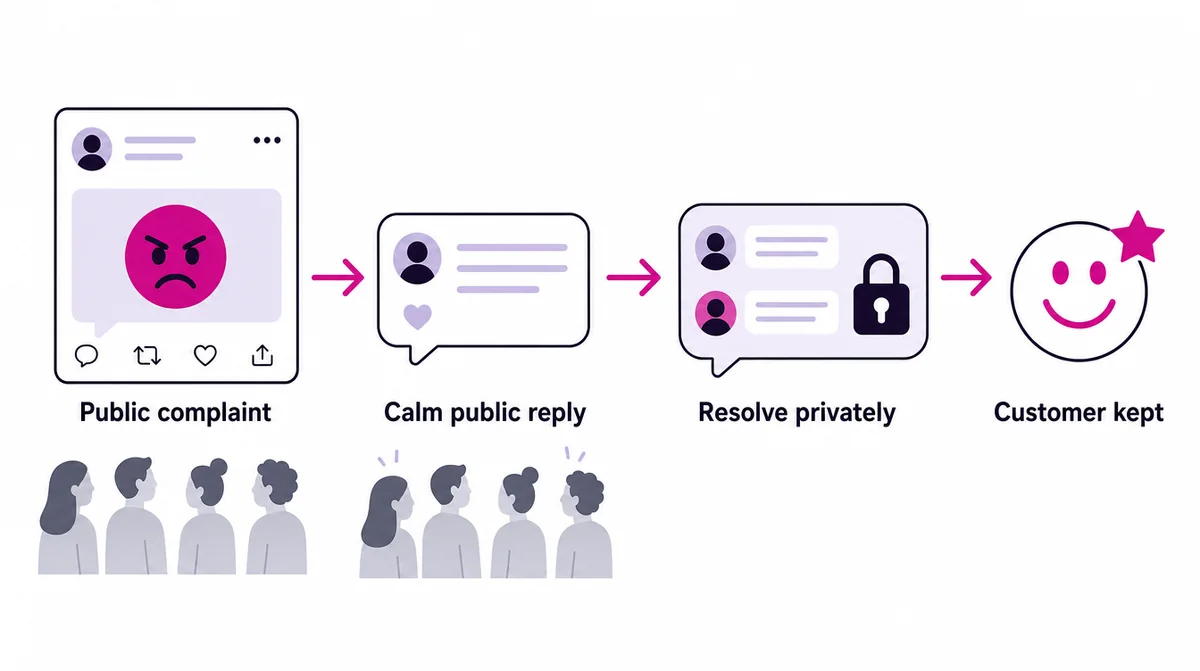
| Step | What to write |
|---|---|
| 1. Acknowledge | Name the specific problem, so they know you read it |
| 2. Take responsibility where it is yours | No excuses, no blaming the customer in public |
| 3. Offer the fix | What you will do, or ask what would put it right |
| 4. Move it private | Give a WhatsApp number or say you have messaged them |
| 5. Close it publicly | Once resolved, a short note under the original comment |
Deleting the complaint is the one move that reliably makes it worse.
What to do when a customer complains publicly has the full structure of a good reply, and what not to say when you are annoyed.
Paid and organic do different jobs
Organic builds trust slowly with people who already know you exist. Paid buys reach quickly among people who do not. They work best together, and they fail in different ways.
The common mistake is boosting posts because the platform suggests it. Boosting optimises for engagement, which buys likes rather than customers. If you are going to pay, run a proper campaign aimed at an action you care about, such as a message or a booking, and judge it on enquiries.
The other mistake is paying to promote a page that then goes quiet. Advertising sends people to look at something. Make sure there is something worth looking at first. Our advertising guide covers paid social properly.
How much time it really takes
Social media fails most often because nobody budgeted the time. This is roughly what doing two platforms properly takes each week for a small business. If you cannot find these hours, hand it over rather than letting the pages go quiet.
| Task | Time a week | Who can do it |
|---|---|---|
| Planning and writing posts | 1 hour, done monthly in one sitting | Owner, or whoever knows the business best |
| Photos and short videos | 1 to 2 hours | Anyone with a phone and daylight |
| Answering messages and comments | 15 minutes a day | Whoever is at the counter, with access |
| Reviewing what worked | 30 minutes a month | Owner |
About three to four hours a week in total. It is not much, but it has to be every week, which is exactly the part that slips first when the business gets busy.
Judge it on enquiries, not applause
Followers and likes are the numbers social platforms show you because they are the numbers that keep you posting. Neither pays anybody.
| Number | Where to find it | What it tells you |
|---|---|---|
| Enquiries from social | Ask every new customer where they found you, and count | Whether social brings business |
| Response time | Your inbox, or the page’s response-time badge | Whether people are kept waiting |
| Saves and shares | Post insights | Content worth keeping, not just liking |
| Profile visits and link clicks | Account insights | Interest turning into action |
| Followers | The page | Reach, and not much else on its own |
If enquiries are flat while the follower count climbs, you have an audience rather than a market, and the content needs to change rather than increase.
Rescuing a page that went quiet
If your page has been silent for months, you do not need to apologise or announce a comeback. You need four weeks of steady, useful activity.
- Week 1. Answer every unanswered message and comment, even old ones, with a short apology for the delay.
- Week 2. Update the profile: photo, hours, phone, WhatsApp link, website, and a pinned post saying what you do.
- Week 3. Post twice, from the five types above, and reply to every response the same day.
- Week 4. Plan the next month in one sitting and decide who answers when you are busy.
After a month of that, the page looks alive again to anybody who checks it before buying, which is the only audience that really matters.
Where this comes from
The primary sources behind the claims above. Each one is worth reading in full if you want the detail.



If you would rather not do it yourself
See our social media service
If you would rather hand it over, we plan the content, post it, and answer the messages, on the platforms that are actually worth your time.
Questions
The things people ask first.
Social media marketing is running the accounts your customers check before they buy: Facebook, Instagram, WhatsApp Business, LinkedIn, TikTok and YouTube. It covers what gets posted, how quickly messages are answered, and whether the page looks active enough to trust.
Fewer than you think. Two done properly beats five done badly. For most businesses here that means WhatsApp Business and Facebook, or Instagram if the product is visual. Add a third only when the first two are running without effort.
Twice a week, planned a month at a time, is the schedule that survives a busy period. Consistency matters more than volume: a steady rhythm for a year beats daily posting for three weeks followed by silence.
Here, yes. It is where enquiries arrive and where sales close, and most businesses run it on a personal account with none of the tools that make it work. Catalogue, greeting and away messages, quick replies and labels take an afternoon to set up.
Rotate five types: the work itself, a common question answered, a price explained, a customer's result with permission, and the people behind the business. Planning by type rather than by idea means you never start the month with a blank page.
Acknowledge every message within a working day, even if the full answer comes later. An automatic first reply that says it is automatic and gives your prices and hours keeps overnight enquiries alive until a person can answer.
Reply in public, quickly and calmly, acknowledging the specific problem and offering to fix it, then take the detail private. Everyone reading is judging your reply, not the complaint. Deleting it is what makes it worse.
Rarely. Boosting optimises for likes and comments, not customers. If you want to pay for reach, run a proper campaign aimed at messages or bookings and judge it on the enquiries it brings.
It depends what you sell. If people check your presence before buying, and here most do, then being active and responsive is worth more than the follower count. Judge it on enquiries received, not on likes.
Next step
Tell us the goal. We will come back with the plan.
No pressure and no obligation. Start with the free audit, or send us a brief and get scope, timeline and cost in writing.
