

Advertising, explained
What Google and Meta ads really cost here, and what makes them work.
A practical guide to paid advertising in Cameroon: what a customer is worth, which platform suits which business, what it costs, tracking, landing pages, reading a report without being misled, and when to switch it off.

Advertising is the fastest thing in marketing, and the easiest to waste.
Paid advertising is the only channel that produces traffic on the day you switch it on. That speed is why people reach for it, and it is also why more money is wasted here than anywhere else in marketing: a campaign can spend a month's budget in a week without anybody noticing it never had conversion tracking installed.
The businesses that do well with ads are not the ones with the biggest budgets. They are the ones who know what a customer is worth to them, who fixed the page the advert points at before spending anything, and who judge the campaign on enquiries rather than on impressions.
This guide covers the decisions that determine whether advertising is an investment or a leak.
 By Nyah Eliud, Founder & Chief Strategist
Updated 20 October 2026
10 min read
Key takeaways
- Work out what one enquiry is worth to you before setting a budget. It is the number every result is judged against.
- Use Google when people already search for what you sell, and Meta or TikTok when you need to create demand.
- Install and test conversion tracking before spending anything, or the platform optimises for the wrong thing.
- Fix the landing page before raising the bid: it is the cheapest lever and it improves every channel.
- Own the ad account and pay the platform directly, and judge the campaign after a month, not a week.
Know what a customer is worth before you set a budget
Every sensible advertising decision starts with one number: what you earn from one customer, including the work they bring back later. Without it you cannot tell a good result from a bad one, and you will end up judging the campaign on what a click cost instead of what a customer cost.
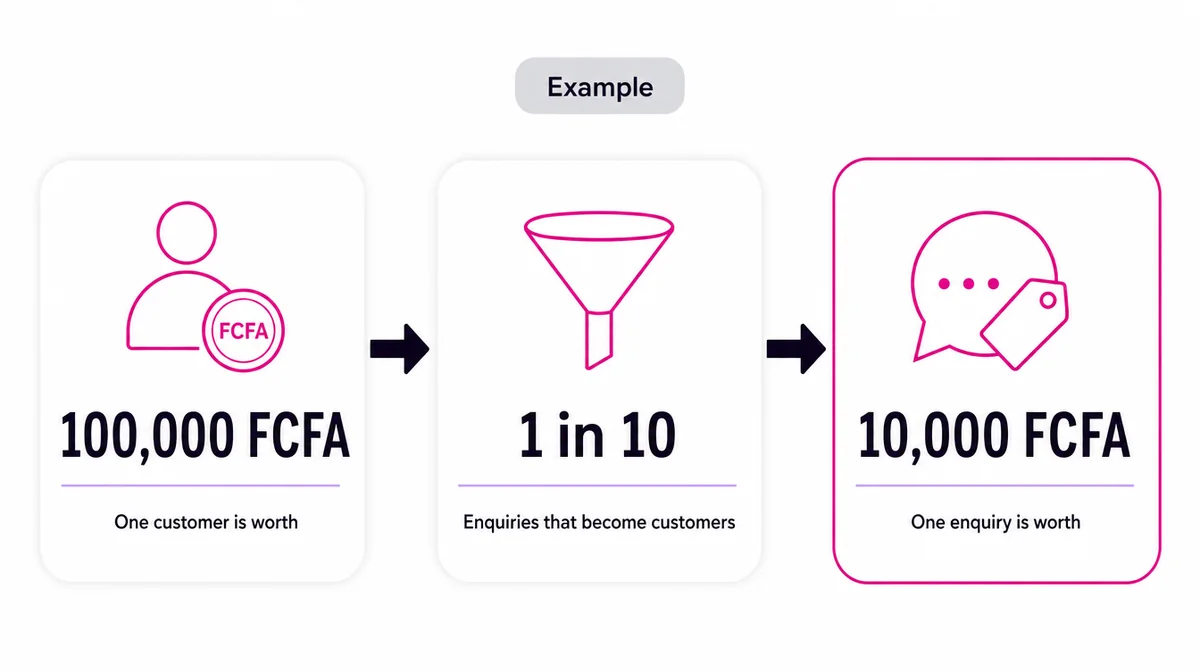
Once you have it the arithmetic is simple. If a customer is worth 100,000 FCFA and one enquiry in ten becomes one, an enquiry is worth 10,000 FCFA to you. Any campaign producing enquiries below that is working, whatever the click price looks like.
| You need | How to find it |
|---|---|
| What a customer is worth | Average first sale, plus repeat business over a year |
| How many enquiries become customers | Count the last twenty enquiries and how many bought |
| What an enquiry is worth | Customer value multiplied by that conversion rate |
| Your break-even cost per enquiry | Anything below the figure above, after your own costs |
This is also the number that tells you when to stop. Advertising has a ceiling: the point where the next customer costs more than they bring. Knowing where that sits turns budget decisions into arithmetic rather than nerve.
Google, Meta or TikTok depends on whether demand already exists
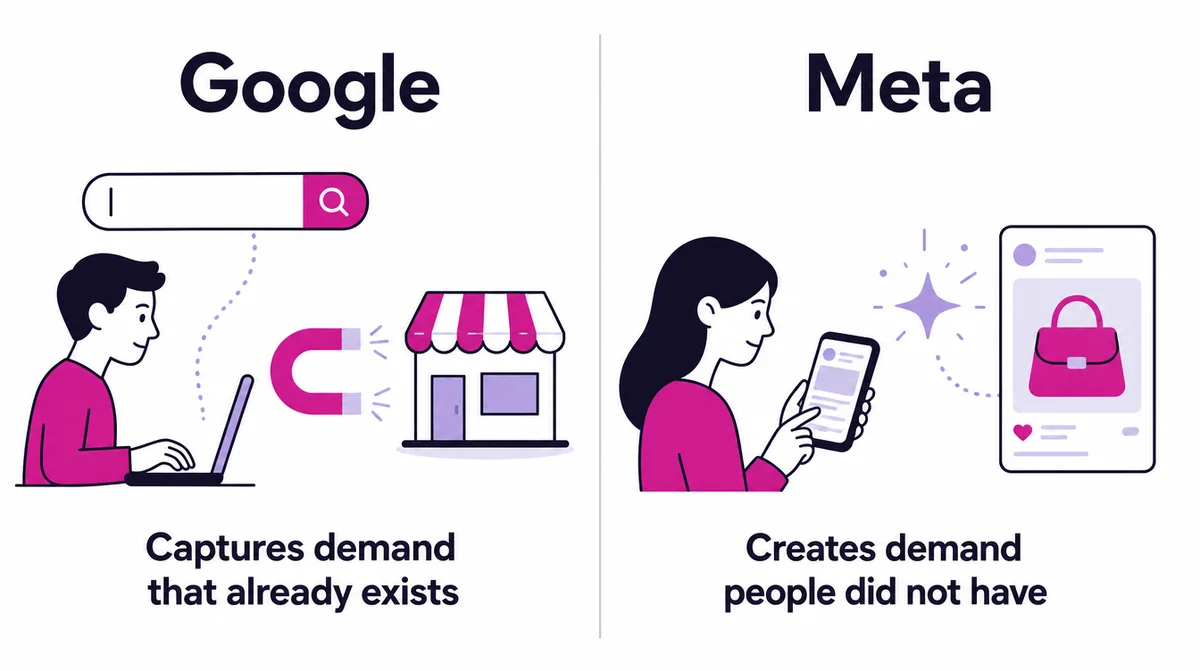
Google captures demand that is already there. Somebody typing your service is looking for it now, which is why search ads convert well and cost more per click. Meta creates demand: Facebook and Instagram put you in front of people who were not looking, which is cheaper per click and slower to convert. TikTok works the same way as Meta, with a younger audience and video only.
| Google Search | Meta (Facebook and Instagram) | TikTok | |
|---|---|---|---|
| What the person is doing | Searching for a solution | Scrolling, not looking to buy | Watching short videos |
| Best for | Services people already look for | Visual products, new categories, local offers | Products that show well on video, younger buyers |
| Cost per click | Higher | Lower | Lower |
| How fast it converts | Fast, intent is high | Slower, needs repetition | Slower, needs strong creative |
| What you need | A strong landing page | Good photos and short videos | Video made for the platform |
If people already search for what you sell, start on Google. If nobody knows the category exists, or the product is visual, start on Meta. Running every platform from day one on a small budget usually produces campaigns with too little data to learn anything from.
The smallest budget worth spendingEnough for thirty to fifty clicks a week on one tightly focused campaign, run for a month. Below that you are not buying customers, you are buying a sample too small to conclude anything from.
What it actually costs here
You pay per click, and the price is set by how many businesses are bidding on the same search. Google runs an auction every time somebody searches, and your position depends on your bid and on the quality of your advert and landing page. A competitive commercial term costs multiples of a quiet one, which is why the honest answer to “what do ads cost in Cameroon” is a range rather than a figure.
Your total cost has two parts, and they should never be mixed up:
| Part | Who you pay | What it buys |
|---|---|---|
| Ad budget | Google, Meta or TikTok, directly from your own account | The clicks and impressions themselves |
| Management fee | Whoever runs the campaigns | Setup, tracking, creative, weekly changes and reporting |
Our own management fees are published: Starter at 100,000 FCFA a month for one platform, Growth at 220,000 for Google and Meta together, and Full Funnel at 380,000 for three platforms plus local SEO. Setup is included when you commit to three months, or 75,000 FCFA per platform otherwise. The ad budget always goes straight from your account to the platform and never passes through us.
What Google and Meta ads really cost in Cameroon has the click ranges and the costs people forget, and every plan is on our ads pricing page.
Install tracking before you spend a franc
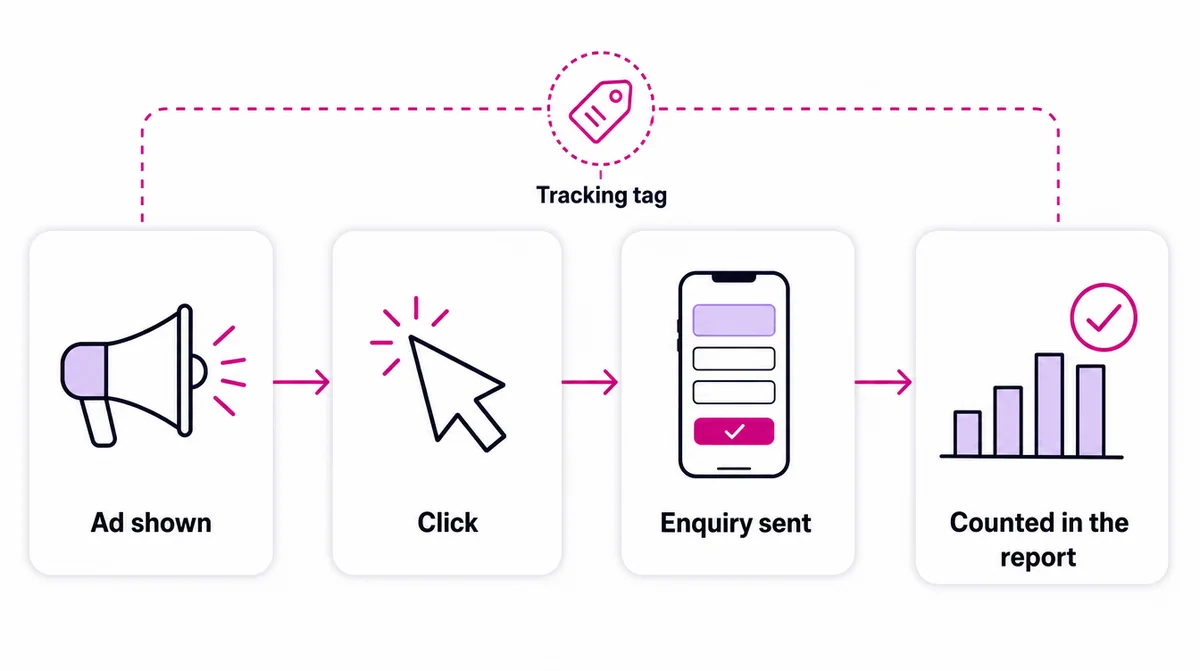
Conversion tracking is what connects an advert to an enquiry. Without it, the platform can tell you how many people clicked but not how many called, filled in the form or bought. You end up optimising for clicks, which is how budgets get spent on people who were never going to buy.
| Action to track | How it is usually tracked |
|---|---|
| Form submitted | A thank-you page or form event, counted by the Google tag or Meta Pixel |
| WhatsApp button tapped | A click event on the button |
| Phone number tapped | A click event, or a Google forwarding number for calls from ads |
| Purchase completed | The order confirmation page, with the order value |
Check it works before launch by completing each action yourself and confirming it appears. A campaign running on broken tracking is not just unmeasured; the platform’s automatic bidding learns from the wrong signal and gets steadily worse.
Clicks without customers is almost never an advertising problem
If people are clicking, the advert worked: somebody wanted what it promised. Whatever went wrong happened after they arrived.
- The page does not repeat the promise the advert made
- It is slow on mobile data, so they leave before it loads
- The form asks for more than somebody will give a stranger
- The campaign is buying research-shaped searches, not buying-shaped ones
- There is no phone number or WhatsApp link for the people who prefer to ask
Raising the budget on a campaign that is not converting buys the same failure more often. Fix the page first: it is cheaper, and it improves every other channel at the same time.
Why your ads get clicks but no customers goes through the diagnosis in order, starting with the cheapest thing to check.
The landing page decides more than the bid does
Two businesses can pay identical amounts per click and wildly different amounts per customer. The gap is the page the advert points at, and it is the cheapest lever available because improving it costs nothing per click. Google also scores landing page experience as part of its auction, so a better page can lower what you pay.
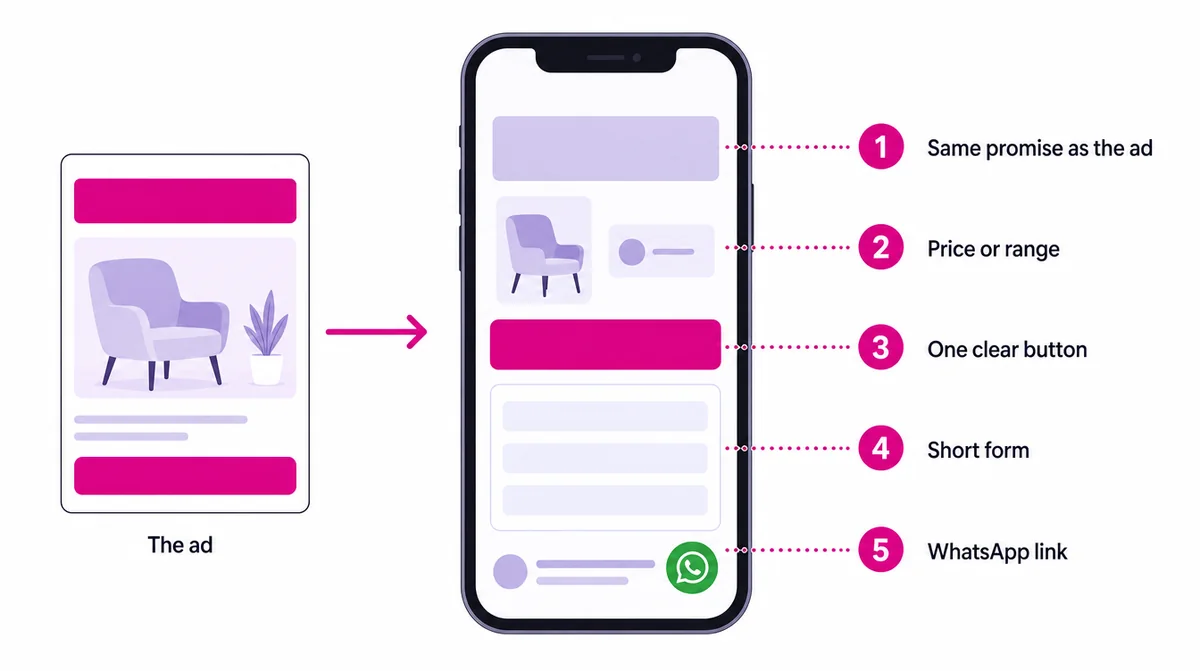
Send paid traffic to a page built for that advert, not to your homepage. Somebody who clicked an advert about roof repairs should land on roof repairs, with the same words, a price or a range, and one obvious way to make contact. Sending them to a homepage listing eight services asks them to start their search again.
- Repeat the promise the advert made, in the same words
- Put the action above the fold, on a phone
- Ask for the fewest fields you can actually work with
- Offer a WhatsApp link as well as a form, because many people will not fill in a form
- Make it load fast on mobile data, because paid visitors leave faster than organic ones
Reading a report without being flattered
A report leading with impressions is leading with its most impressive number rather than its most useful one. Impressions are context. Conversions are the point.
| Number | What it means | Flattering or useful? |
|---|---|---|
| Impressions | How many times the ad was shown | Flattering on its own |
| Click-through rate | The share of people who clicked | Useful for judging the advert |
| Cost per click | What each click cost | Useful, but not the goal |
| Conversions | Enquiries, calls or sales counted by tracking | The point |
| Cost per lead | Spend divided by conversions | The number to compare with what an enquiry is worth |
| Search terms | What people actually typed to see your ad | The report nobody opens and everybody should |
The search terms report shows what people actually typed to trigger your advert, which is regularly not what you thought you were buying. Adding the irrelevant ones as negative keywords is the quickest saving in most accounts.
How to read an ad report without being fooled covers the numbers that flatter, and the ones that tell you the truth.
Advert creative that works here
On Meta and TikTok the creative is the targeting. The platform shows your advert to whoever reacts to it, so the picture and the first line decide who sees it as much as any audience setting does.
| Element | What works | What to avoid |
|---|---|---|
| Opening | The problem or the result, in the first line or first second of video | Your logo and company name first |
| Picture | Your real product, premises or customer, in daylight | Stock photos of people who are obviously not here |
| Price | A price or a starting price when you can give one | “Contact us for price” on something that has a price |
| Language | French and English versions, tested separately | One bilingual advert trying to do both |
| Video | Short, vertical, captioned, made on a phone | A long, polished brand film nobody watches past second three |
| Call to action | One action: message us, book, buy | Three different buttons and a phone number |
Make three versions of every advert and let the results choose. You will usually be surprised which one wins, which is exactly why you test rather than guess.
Click-to-WhatsApp ads
For many businesses here the best landing page is not a page at all. A click-to-WhatsApp advert opens a chat with your business instead of a website, which suits customers who would rather ask a question than fill in a form.
- It removes a step. No page to load on mobile data, no form to fill in
- It puts the lead where you already work, in WhatsApp, with the advert they came from
- It needs somebody to answer quickly. A chat that waits four hours loses the customer the advert paid for
- It needs a first reply ready. An automatic greeting with your prices and hours keeps people talking until a person picks up
That last point is where advertising and automation meet. Our automation service sets up the instant reply, and WhatsApp Business for Cameroonian businesses covers the settings worth getting right first.
Remarketing is usually the cheapest thing you can run
Most people do not buy on the first visit, and that is normal rather than a failure. Remarketing shows adverts only to people who already came to your site, which makes it far cheaper per customer than reaching strangers.
It is also the campaign most small businesses here never switch on. If you are going to spend money attracting people to a website, spending a little more to reach the ones who arrived and left is close to the easiest decision in advertising.
Keep it modest and keep it short. Following somebody around the internet for three months after they looked once is how remarketing gets a bad name. It also depends on tracking cookies, so your cookie notice and privacy policy need to say so.
Own the account, whoever runs it
The ad account should be created in your name, with your agency added as a manager. It sounds like paperwork and it is the difference between changing supplier and starting again.
An account carries its own history: what converted, what did not, the audiences you paid to build. Lose access and you lose all of it, and the next campaign starts from zero at your expense. You also pay the platform directly, so you can always see exactly what was spent rather than taking somebody’s word for it.
Your first 30 days
A sensible first month on a small budget looks like this. It is slower than switching everything on at once, and it produces something you can actually learn from.
- Week 1. Work out what an enquiry is worth. Build or fix one landing page. Install and test tracking.
- Week 2. Launch one campaign on one platform, tightly focused on one service and one area.
- Week 3. Read the search terms or audience report. Remove what is wasting money. Do not change the budget yet.
- Week 4. Compare cost per lead with what an enquiry is worth, and decide: continue, adjust, or stop.
When to switch it off
Advertising is the easiest channel to stop, which people forget while a campaign quietly spends. Set the review date when you launch: one month, then decide.
Switch off when the cost per customer has been above what a customer is worth for a full month and nothing you changed moved it. Keep going when the number is improving even if it is not there yet, because early campaigns are always the most expensive ones you will run.
When you do switch off, the work you put into the landing page, the tracking and the account history stays with you. That is one more reason to own the account.
Where this comes from
The primary sources behind the claims above. Each one is worth reading in full if you want the detail.



If you would rather not do it yourself
See our advertising service
If you would rather somebody ran it properly, we handle strategy, setup, ad creative and regular optimisation, and we will tell you before we start whether your numbers can work.
Questions
The things people ask first.
Paid advertising is buying placement on Google, Facebook, Instagram or TikTok so your business appears in front of the people most likely to buy. It is the fastest source of enquiries available, because clicks start the day a campaign goes live.
You pay per click, and the price depends on how many businesses are bidding on the same search. The more useful question is what an enquiry costs you, which depends on your landing page as much as your bid. Our ad cost guide has the ranges.
Starter is 100,000 FCFA a month for one platform, Growth 220,000 for Google and Meta, and Full Funnel 380,000 for three platforms plus local SEO. Setup is included with a three-month commitment, or 75,000 FCFA per platform otherwise. The ad budget is separate and paid to the platform.
You pay the platform directly, from an account in your own name with us added as a manager. We charge separately for managing campaigns. It means you see exactly what was spent, and the account stays with you if we ever stop working together.
Google if people already search for what you sell. Facebook or Instagram if they do not know the category exists, or the product is visual. Which is right depends on whether demand exists, not on which platform is more popular.
Conversion tracking counts the enquiries, calls and sales that come from your ads, not just the clicks. You need it before you spend anything, because without it you cannot tell which ads work and the platform's automatic bidding learns from the wrong signal.
Clicks arrive on day one. Whether it is working is a question for the end of the first month, once there is enough data to separate signal from noise. Judging a campaign in its first week is how good campaigns get switched off.
No. Nobody controls the auction or how people respond. What we commit to is the work, honest tracking, and a monthly report showing spend, leads and cost per lead, so you can decide with real numbers.
Yes, and it is often where the quickest wins are. We audit the account first: whether conversion tracking was ever installed, and how much budget is leaking into placements or broad terms nobody intended to buy.
Next step
Tell us the goal. We will come back with the plan.
No pressure and no obligation. Start with the free audit, or send us a brief and get scope, timeline and cost in writing.
