

Selling online, explained
How to sell online in Cameroon without losing money on delivery.
What it actually takes to run an online store here: proving demand first, knowing what a sale costs you, taking mobile money, choosing a platform, pricing delivery so it does not eat the margin, and fixing a store that gets visitors but no orders.
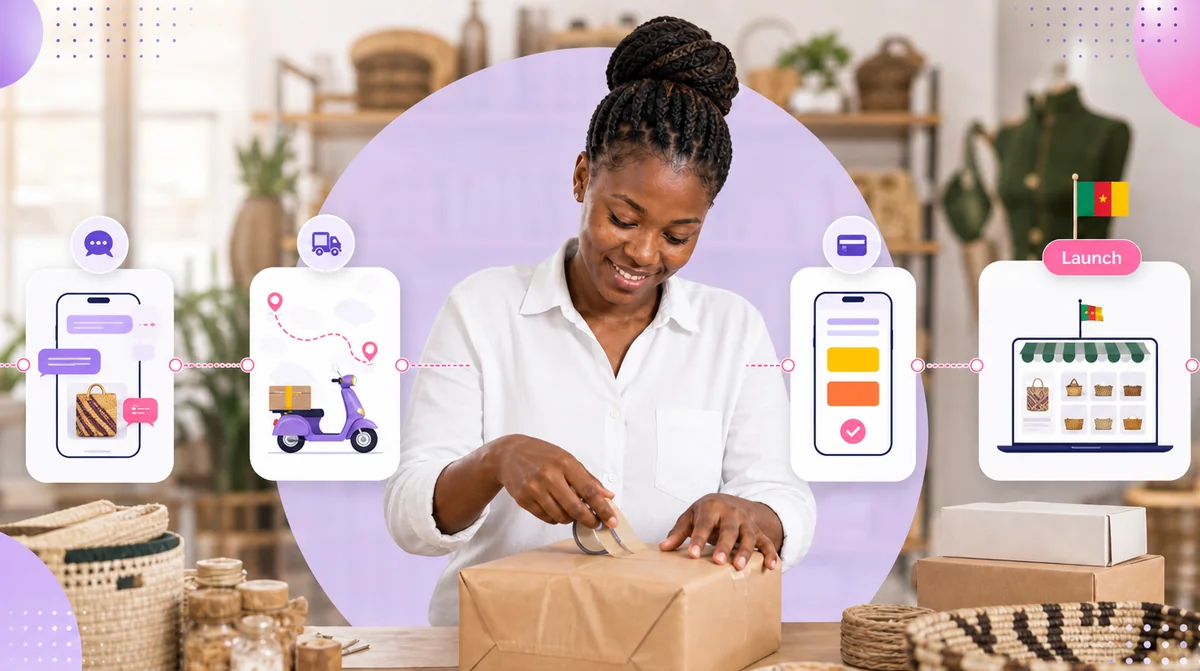
The storefront is the easy part.
Nearly everyone plans an online business in the wrong order. They design the shop, fill it with products, launch it, and then discover that delivery costs more than they charge, that most customers cannot pay the way the checkout expects, and that nobody was waiting for the products in the first place.
The businesses that work here did it backwards from that. They sold through WhatsApp first, found out what people actually wanted and what a delivery really costs, and then built a shop to remove the manual work. The website was the last step, not the first.
This guide follows that order. Demand, then money, then delivery, then the store, then the reasons a store with traffic still makes no sales.
 By Nyah Eliud, Founder & Chief Strategist
Updated 20 October 2026
10 min read
Key takeaways
- Sell on WhatsApp first. Build a store when the manual work becomes the bottleneck, not before.
- Work out the full cost of one sale, including delivery, payment fees, packaging and time, before you set a price.
- Take MTN Mobile Money and Orange Money at checkout, and test both with real money before launch.
- Price delivery by zone from what a drop really costs you, and show the rates on every product page.
- If you have visitors and no orders, fix the checkout before you buy more traffic.
Sell in the right order
Every successful store we have built here followed roughly the same five steps, and every struggling one skipped at least two of them. The order matters because each step tells you something the next one depends on.
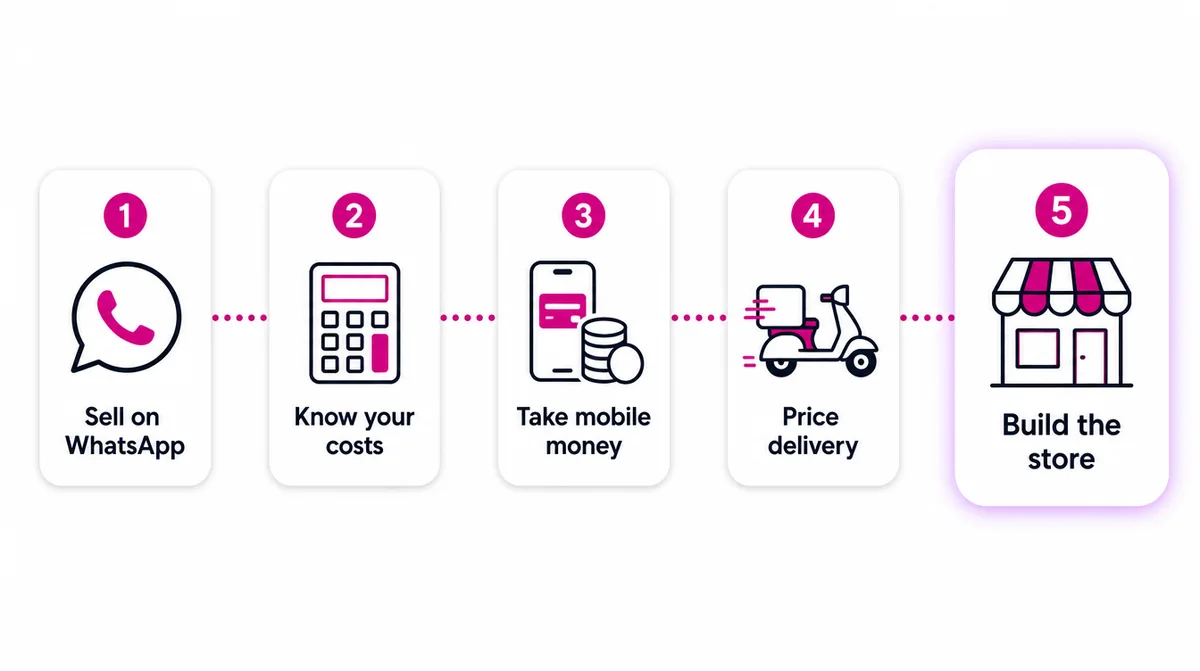
- Sell on WhatsApp first. It proves demand and teaches you the questions customers ask.
- Know what a sale costs you, all of it, before you set a price.
- Take mobile money, because that is how most of your customers pay.
- Price delivery by zone, from what a drop really costs.
- Build the store to remove the manual work you now understand.
Prove there is demand before you build anything
A shop full of products nobody has asked for is an expensive way to learn what people do not want. If you are already taking orders in messages, you have the only proof that matters. If you are not, get it first, because it costs nothing but a few evenings and it changes what you build.
The website earns its place at a specific moment: when the manual work becomes the bottleneck. The same questions answered forty times. Prices quoted one message at a time. An order lost somewhere in a thread. That is when a store starts paying for itself, and it is a moment you can recognise rather than guess at.
- You answer the same five questions about price, size and delivery every day
- You have lost track of an order, or of who has paid
- Customers ask for a catalogue link you do not have
- You are turning down orders because you cannot keep up with the messages
If two or more of those are true, you are ready. The full order of operations, from first sale to first shop, is in how to start selling online in Cameroon.
Work out what a sale costs you before you price anything
This is the step people skip, and it decides whether the business works. A sale has more costs in it than the price you paid for the item, and every one of them comes out of the same price.
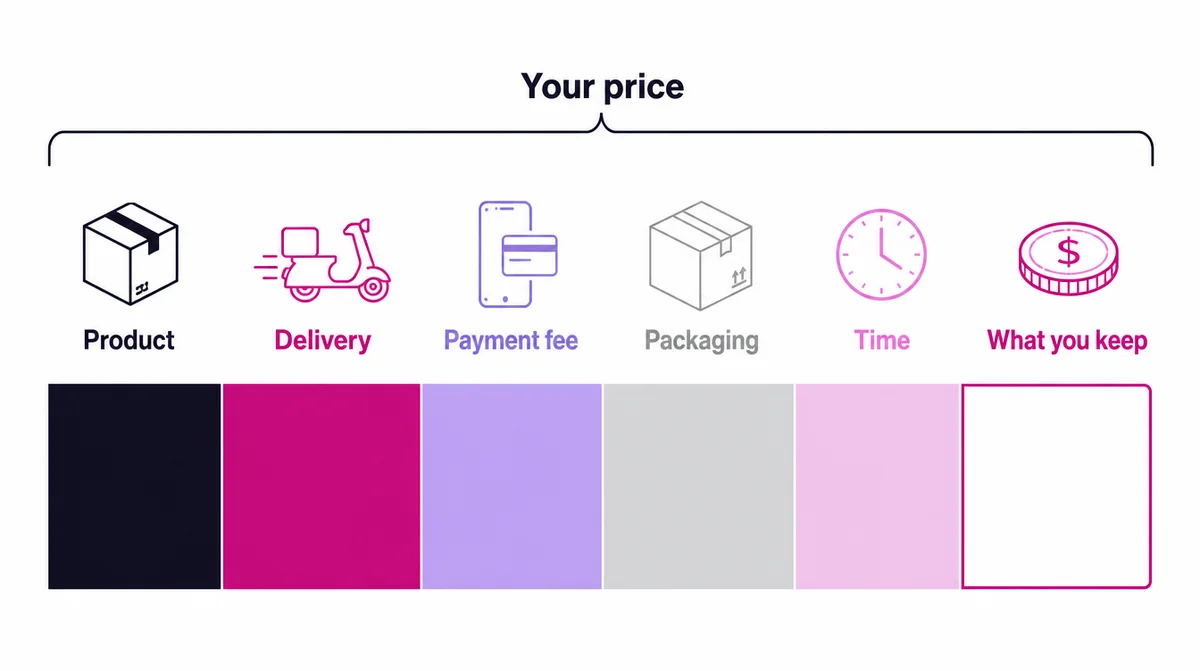
| Line | Example | Where the number comes from |
|---|---|---|
| Selling price | 15,000 FCFA | What the customer pays for the item |
| Cost of the item | −8,000 FCFA | Your supplier invoice |
| Delivery you pay | −2,000 FCFA | What the rider actually charged, not what you bill |
| Delivery you charge | +1,500 FCFA | Your published rate for that zone |
| Payment fee | −300 FCFA | Your provider’s rate on the amount collected |
| Packaging | −200 FCFA | Bags, boxes, tape |
| What you keep | 6,000 FCFA | Before your own time, rent and advertising |
The figures above are an example, not a benchmark. Put your own in. If what remains is thin, selling online will not fix it, it will multiply it. Fix the margin before you fix the storefront.
The cost people forgetTime. Somebody confirms the order, packs it, sends the rider, answers “where is my parcel” twice and chases payment. If that is you, it is still a cost, and it is the one a good store removes.
Take mobile money, or lose most of your customers at the last step
A checkout accepting only cards asks most of this country to give up at the final moment. MTN Mobile Money and Orange Money are not an optional extra here, they are the payment method, and a store without them pushes buyers back into your inbox where you handle each order by hand again.
A payment gateway sits between your website and the operator: the customer taps pay, approves it on their phone, and the gateway tells your site the order is paid. That last step is the point of the whole thing, because without it somebody has to watch a phone for notifications and match them to orders manually.
| Ask the provider | Why it matters |
|---|---|
| What is the fee on each collection? | It belongs in your price from day one, not after the first statement |
| How long until the money reaches my account? | Settlement ranges from the same day to over a week, and that decides how you buy stock |
| Do you support both MTN and Orange? | Covering one network turns away the other network’s customers |
| What happens when a payment half-fails? | The customer was charged but the order shows unpaid. You need a process, not an argument |
| Can I test with real money? | Test mode proves the code, not that the money arrives |
| Is the merchant account in my business’s name? | So the money, and the relationship, are yours |
Accepting MTN MoMo and Orange Money covers each of these in detail, including what to do when a payment half-fails, which it eventually will.
Test with real money, not just test modePut small real transactions through on both networks, from a real phone, on mobile data, before anyone else sees the store.
WooCommerce or Shopify
The real difference is not features, it is who carries the cost and when. Shopify is a monthly subscription billed in dollars: you rent a shop that is maintained for you. WooCommerce is free software on hosting you control: more work to set up, more responsibility afterwards, no monthly platform fee.
| Question | WooCommerce | Shopify |
|---|---|---|
| Monthly platform fee | None; you pay for hosting | Yes, billed in dollars |
| Mobile money | Connects through local gateways | Depends on what its payment apps support here |
| Who maintains it | You, or a care plan | Shopify maintains the platform |
| Content and blog | Full WordPress site alongside the shop | Possible, but more limited |
| Moving away later | You own the site and the data | You can export data, the design stays behind |
For a business earning in FCFA the subscription difference compounds, because a dollar fee grows every time the exchange rate moves against you, in a year when you may not have sold any more than the last one.
Four questions settle it in practice: how will most customers pay, who maintains it in six months, how predictable is your income, and do you need a shop and a content site in one place. For most businesses here the payment question decides it, and the answer is WooCommerce.
The full comparison, including what moving between them later actually costs, is in WooCommerce or Shopify for a Cameroonian business.
Delivery is where the margin quietly disappears
A flat national rate is simple and quietly punishing: nearby customers subsidise distant ones, and the orders you are most pleased to receive are the ones costing you most.
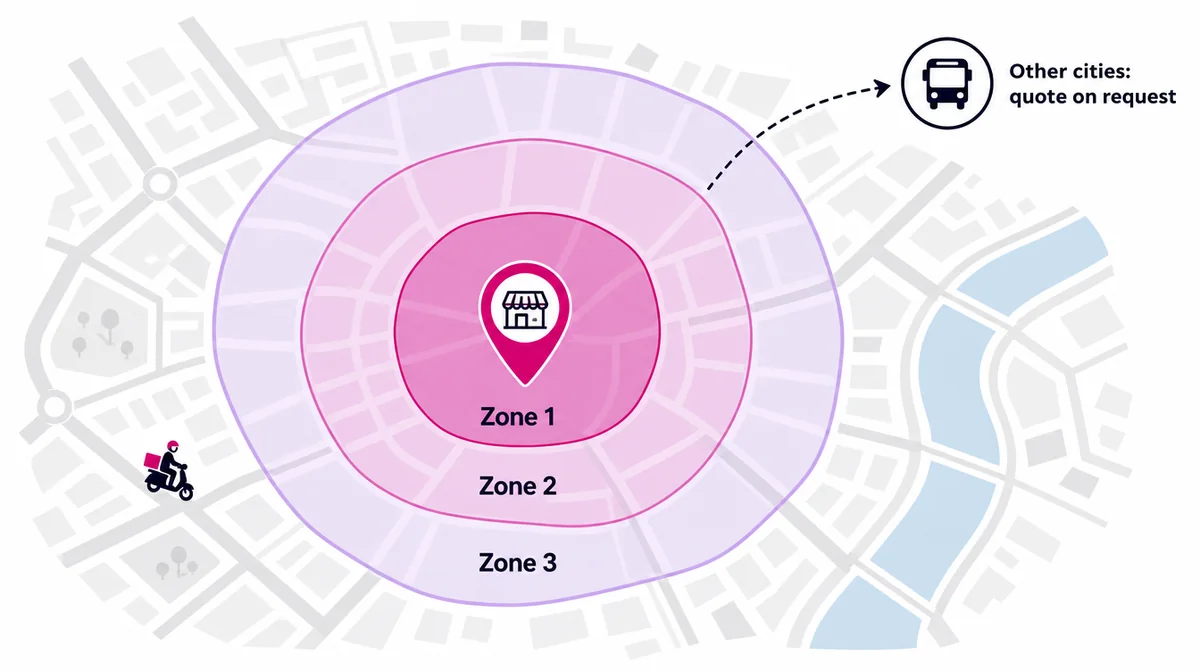
Zones fix it. Group the areas you serve into three or four bands with an honest rate each, and quote anywhere else on request. It takes an afternoon and it protects every order afterwards. Before setting the rates, deliver ten orders yourself and write down what each actually took.
| Zone | Example for a shop in Akwa, Douala | How to set the rate |
|---|---|---|
| Zone 1 | Akwa, Bonanjo, Bonapriso, Deido | Your actual cost of a short run, rounded up |
| Zone 2 | Bonamoussadi, Makepe, Kotto, Logbaba | A longer run, plus traffic time |
| Zone 3 | Bonabéri, PK areas, Japoma | The far edges, including bridge traffic |
| Other cities | Yaoundé, Bafoussam, Buea and beyond | Quoted per order, sent through a travel agency |
Riders, couriers or travel agencies
| Option | Best for | Watch out for |
|---|---|---|
| Your own rider | Steady volume in one city | Wages, fuel and a motorbike to maintain |
| Freelance riders | Variable volume | Reliability, and cash collected on delivery |
| Courier companies | Businesses that want tracking and a receipt | Higher cost per parcel |
| Travel agency parcel services | Sending between cities | Collection times and packaging that survives the trip |
Decide the failed-delivery rule before it happens rather than during the argument: how many attempts, who pays for the second, how long you hold an item. Write it on the website. A customer who knows the rule complains far less than one who discovers it.
Delivery for online stores covers zones, riders versus couriers, and why you should promise slightly slower than you can deliver.
Product pages that sell
Nobody can pick it up, so the page is the product. A phone camera is genuinely fine for the photographs. A dark picture on a patterned bedsheet with your hand in the frame is not.
- Daylight, near a window, no flash
- One plain background, the same for every product
- Three or four angles, and one showing scale beside something familiar
- The same crop and size every time, so the shop looks like a shop
Then the words. Every product page should answer, before the customer has to message you:
| Question | Answer it with |
|---|---|
| What exactly is it? | Size, colour, material, what is in the box |
| Is it in stock? | A live stock count, or an honest delivery date |
| What will it cost to get it to me? | The delivery rate for each zone, on the page |
| How do I pay? | The MTN and Orange logos, near the price |
| What if it is wrong? | Your return rule, in one sentence |
| Has anyone bought it? | Reviews or photos from real customers |
Photographing the products properly is the highest-return afternoon in the whole project, and it is the part you can do yourself before anybody builds anything.
If you have visitors and no orders, the checkout is the suspect
When sales are flat the instinct is to buy more traffic. That is the expensive answer and usually the wrong one: if a hundred people arrived and nobody bought, the hundred were not the problem.
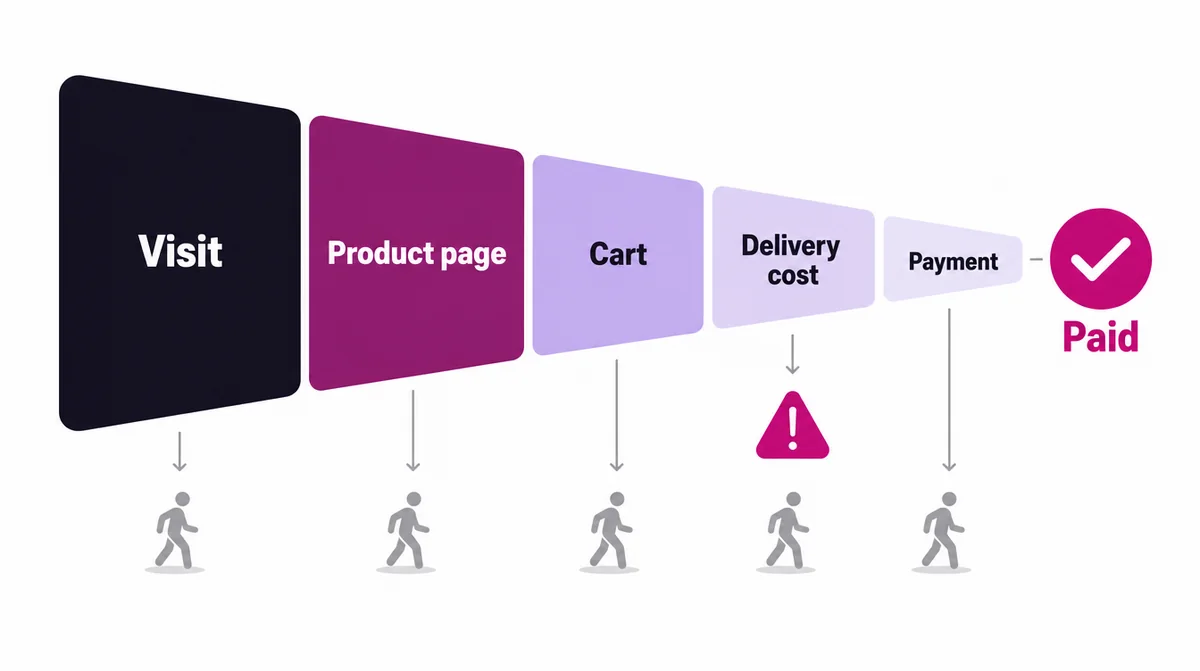
The Baymard Institute, which has studied checkouts for years, puts average cart abandonment at about 70 percent across 50 studies. In its survey of shoppers in the United States, the most common reason for leaving at checkout was extra costs such as delivery being too high. The market is different here, but the lesson travels: show the delivery cost early.
| Problem | Fix |
|---|---|
| The checkout does not take mobile money | Add MTN and Orange through a gateway |
| Delivery cost appears as a surprise at the end | Show the zone rates on every product page |
| An account is required before paying | Allow checkout as a guest |
| Photographs are too dark or too few | Reshoot in daylight, three or four angles |
| The page is slow on mobile data | Compress the images and trim the plugins |
Open your own store on your phone, on mobile data, away from the office wifi, and buy something. Time it. Count the taps. That five-minute exercise finds more lost revenue than a month of extra advertising.
Why your online store gets visits but no sales works through each of the five, and the trust questions your product page is probably not answering.
Tell people where the parcel is
The single most repeated question any seller here receives is where an order has reached, and every one of those messages costs somebody time. A status the customer can check themselves removes most of them. An automatic message at each step removes most of the rest.
| Moment | Message the customer receives |
|---|---|
| Order placed | Confirmation with the items, the total and the delivery zone |
| Payment received | A receipt, and when to expect dispatch |
| Out for delivery | The rider’s name and number, and a time window |
| Delivered | Thanks, and a link to leave a review |
It is unglamorous work and it pays back faster than advertising bought with the same money, because it does not just save the time, it stops the anxious customer who was about to ask for a refund. Our automation service sets these up on WhatsApp.
Returns, refunds and the rules you write down
Every store eventually sends the wrong size, a damaged item or a parcel that never arrives. The stores that keep their reputation are the ones that decided in advance what happens, and said so on the website.
- How many days a customer has to report a problem
- Which items cannot be returned, such as opened cosmetics or food
- Who pays delivery on a return, and in which cases
- Whether you refund, exchange or offer credit, and how fast
- How a failed delivery is handled, and how many attempts are included
Keep it to a short page in plain language. Then follow it every time, because a rule applied to one customer and not another is the quickest way to an angry review.
The numbers worth watching
A store produces a lot of data. Five numbers tell you almost everything about whether it is healthy.
| Number | What it tells you | Where to find it |
|---|---|---|
| Conversion rate | The share of visitors who buy | Your store dashboard or Google Analytics |
| Average order value | How much each order is worth | Your store dashboard |
| Abandoned carts | How many people start and do not finish | Your store dashboard |
| Failed deliveries | How often a parcel comes back | Your delivery records |
| Repeat customers | Whether people come back | Your customer list |
Look at them monthly, not daily. A single day is noise. A month shows you which of the earlier sections in this guide needs your attention next.
Where this comes from
The primary sources behind the claims above. Each one is worth reading in full if you want the detail.





If you would rather not do it yourself
See our eCommerce service
If you would rather have it built properly, we handle the catalogue, the mobile money gateway, delivery zones and the training, and every login is yours.
Questions
The things people ask first.
An eCommerce website is an online store that takes orders and payments without a phone call. In Cameroon that means MTN Mobile Money and Orange Money at the checkout, stock counts that stay accurate as orders arrive, and delivery zones priced to match what a drop actually costs.
Online stores start at 600,000 FCFA with us, because the work sits in payments, stock and delivery rather than in design. A simple catalogue with no checkout is considerably less. We quote in writing on the catalogue you actually have.
Yes, through a payment gateway that connects your store to the operators. It is the part most stores here skip or get wrong. We set it up, connect it to your merchant account, and put real transactions through both networks before launch.
WooCommerce for most businesses here: no monthly platform fee in dollars, easier local payment integration, and you own everything. Shopify when you want nothing to maintain and are comfortable paying monthly for that.
Zones rather than a flat rate. Group the areas you serve into three or four bands, price each one from what a delivery actually costs you, and quote anywhere else on request. Deliver ten orders yourself before setting the rates.
Most sellers here use the parcel services of the intercity travel agencies, quoted per order, or a courier company when the customer wants tracking. Package for a long trip, send the customer the collection details, and agree who collects.
Not immediately. Sell in messages until the manual work becomes the bottleneck, then build. The store's job is to remove repetition: quoting, confirming, taking payment and telling people where their order is.
Most often because of a surprise at the end: a delivery cost they did not expect, a payment method they cannot use, or an account they must create. Show delivery rates early, take mobile money, and allow checkout as a guest.
How long customers have to report a problem, which items cannot be returned, who pays delivery on a return, whether you refund or exchange, and how failed deliveries are handled. Keep it short, put it on the site, and apply it the same way every time.
Next step
Tell us the goal. We will come back with the plan.
No pressure and no obligation. Start with the free audit, or send us a brief and get scope, timeline and cost in writing.
